The 2026 Fire Horse Year: Why General Forecasts Fail (And How to Audit Your Chart’s Ecosystem)
Published on August 8, 2026•6 min read
Why Millions Dread 2026 (And Why Most Forecasts Are Wrong)
As we approach 2026, the Internet is already buzzing with alarming predictions about the Year of the Fire Horse (Bing Wu). In traditional folk astrology, the Fire Horse is often portrayed as chaotic, destructive, or even cursed—a year of sudden upheavals, wild temperaments, and financial instability.
If you have looked up your Chinese Zodiac animal or listened to general annual forecasts, you might be bracing for impact.
However, in analyzing hundreds of individual charts, I have observed a completely different pattern: for a large portion of the population, a Fire Horse year is not a disaster at all. In fact, it is frequently the most explosive, breakthrough year of their entire decade.
The reason general forecasts fail is simple: they treat astrology as a one-size-fits-all horoscope. In the BaZi (Eight Characters) system, an annual pillar is not a decree of fate. It is simply the macro climate passing over your individual personal ecosystem.
Understanding how the 2026 climate interacts with your specific terrain is the difference between thriving during a season of intense growth and burning out under extreme friction.
Deconstructing Bing Wu: The Physics of the Fire Horse Climate
To understand 2026, we must strip away the mystical horror stories and examine the underlying energetic architecture.
In the 60-Year Sexagenary Cycle, 2026 is governed by Bing Wu:
- ●Bing ( - Yang Fire): The Heavenly Stem representing the Sun, radiating concentrated thermal light and relentless heat from above.
- ●Wu ( - Horse / Yang Fire & Earth): The Earthly Branch representing the height of summer, an active volcano, or an uncontrollable wildfire on the ground.
When Bing sits atop Wu, there is zero moisture in the pillar. It represents pure, unadulterated thermal acceleration.
In ecosystem terms, the 2026 Fire Horse year is an intense, scorching summer season. It is an energy multiplier. Whether an intense summer is a blessing or a catastrophe depends entirely on the pre-existing state of your internal terrain.
The Two Ecosystem Scenarios: Thawing vs. Drought
When this scorching macro climate rolls in, human experiences split into two broad categories based on their chart's baseline temperature and moisture levels.
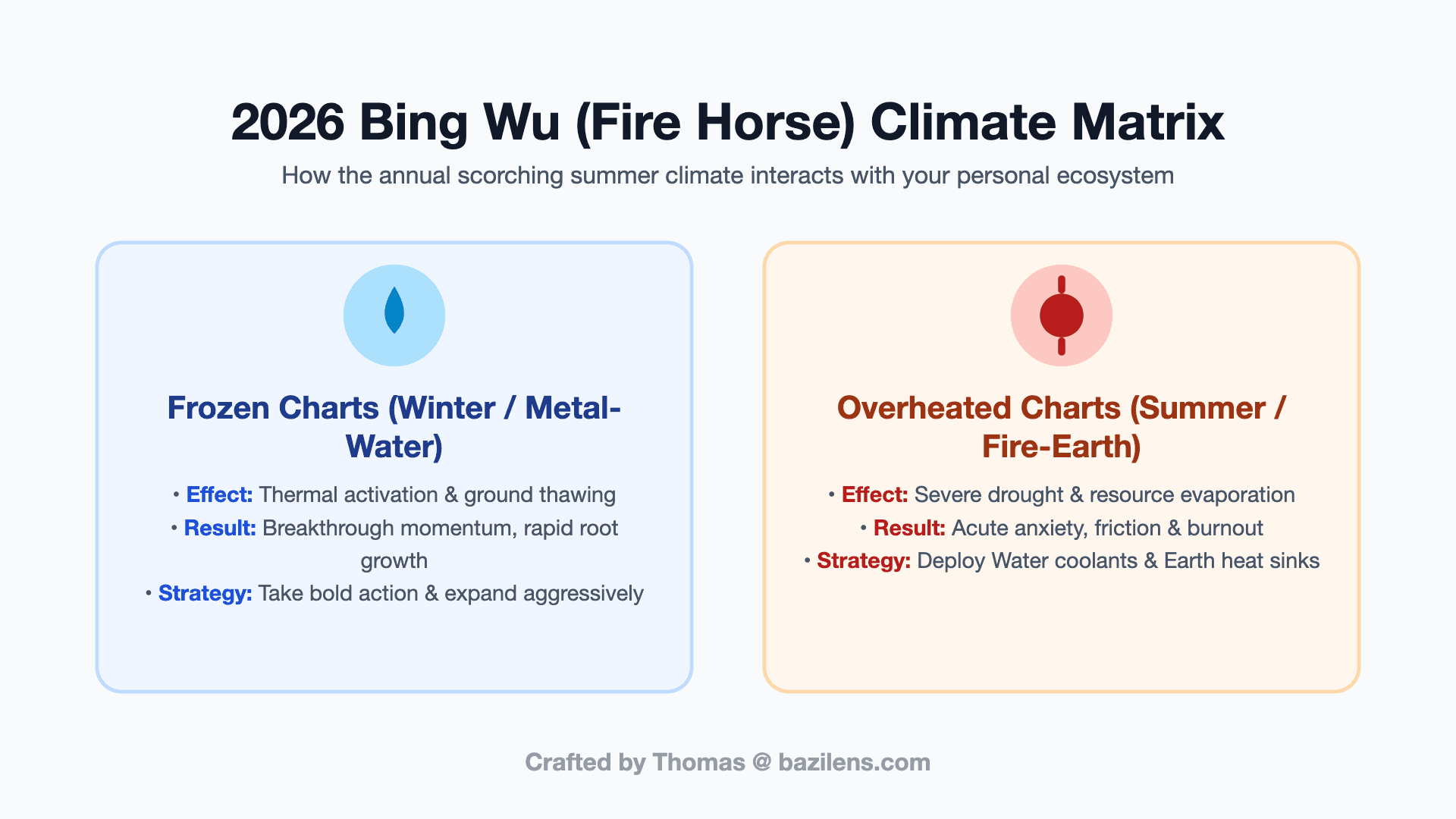
Scenario A: The Frozen Ecosystem (Explosive Momentum)
Consider a chart planted in the dead of winter (born in December or January) with heavy Rat (Zi) or Ox (Chou) energy, or a chart dominated by cold Metal and Water.
Prior to a Fire Horse year, this individual often experiences inertia. Their core engine is functioning, but the ground is frozen hard. Roots cannot expand, decisions feel sluggish, and projects take twice as long to yield results. They are surviving, but not expanding.
When the 2026 Fire Horse arrives:
- ●The Sun (Bing) penetrates the ice age.
- ●The ground thaws, melting the frost and unlocking nutrients trapped in the cold soil.
- ●The system receives the exact thermal energy its roots need to activate.
For a frozen ecosystem, 2026 is the ultimate green light. What others perceive as "chaotic heat" manifests for them as sudden clarity, rapid expansion, and unshakeable momentum.
Scenario B: The Scorching Desert (Severe Drought & Friction)
Now consider the opposite: an individual born at the peak of summer (June or July) with an ecosystem already packed with Snake (Si), Horse (Wu), or dry Earth (Wei/Xu).
Their internal terrain is already running hot. Adding the 2026 Fire Horse to this chart is the ecological equivalent of throwing gasoline onto an active wildfire.
When an already-heated system encounters more Fire:
- ●Moisture and Water reserves evaporate instantly.
- ●Friction manifests as acute anxiety, emotional volatility, imposter syndrome, and severe physical burnout.
- ●The person finds themselves working frantically, putting out fires everywhere, but producing nothing but ash.
For these individuals, 2026 requires deliberate engineering and proactive cooling strategies.
Real-World Case Studies from Community Diagnostics
To see this ecological dynamic in action, let us examine two real-world chart architectures from our community diagnostic sessions (sanitized for privacy).
Case Study 1: Alex (The Thawed Engine)
- ●Baseline Architecture: Yin Metal Day Master born in the peak of Winter (Zi Month).
- ●The Problem: For five years, Alex struggled with career inertia. Despite having strong analytical skills, every initiative felt like dragging heavy machinery through mud.
- ●The Macro Shift: During a previous Fire-dominated cycle, Alex expected severe stress based on online pop-astrology warnings. Instead, the sudden influx of Fire provided the missing thermal catalyst to forge his Metal and warm his frozen soil. He secured a major executive role and doubled his output.
- ●2026 Outlook: The 2026 Fire Horse will serve as a massive growth cycle for Alex's ecosystem.
Case Study 2: Sarah (The Overheated Soil)
- ●Baseline Architecture: Yang Earth Day Master born in late Summer (Wei Month) surrounded by strong Fire Stems.
- ●The Problem: Sarah suffered from chronic anxiety and sudden physical exhaustion whenever high-energy annual cycles arrived.
- ●The Macro Shift: During the last Fire year, Sarah pushed herself to match the frantic pace around her. Because her soil had zero moisture, her system experienced an internal meltdown, resulting in a three-month medical leave.
- ●2026 Outlook: Sarah needs to treat 2026 not as a year for ruthless hustle, but as a year to build heavy "coolants" and protective boundaries.
Actionable Solutions: How to Build Your "System Patch" for 2026
If an audit of your chart reveals that 2026 will bring excess heat to an already dry ecosystem, you cannot fight fire with fire. You need to implement structural coolants:
1. Prioritize Water (The Coolant Layer)
- ●In System Mechanics: Water restores moisture and cools the engine.
- ●In Daily Action: Set non-negotiable boundaries on work hours. Schedule forced periods of reflection, meditation, and physical rest. Do not over-commit to new projects out of fear of missing out.
2. Prioritize Earth (The Heat Sink)
- ●In System Mechanics: Dry Earth absorbs excess Fire and converts chaotic heat into stable structure.
- ●In Daily Action: Build grounding, predictable daily routines. Channel intense creative heat into long-term, structured documentation rather than impulsive real-time reactions.
Developer Reflections: Moving Beyond Predictive Fear
As a developer building diagnostic frameworks for BaZi, my goal is to strip away the fatalistic fear that plagues traditional astrology.
Astrology is not a script that happens to you; it is a weather report for your internal architecture. You do not panic when a weather forecast predicts a heavy snowstorm—you simply put on a heavy coat and check your heating system.
The 2026 Fire Horse is neither a curse nor a magic bullet. It is an intense thermal season. Audit your ecosystem, prepare your coolants if necessary, and use the macro climate to build deliberately.
Next Steps
Stop guessing how annual cycles impact your life based on generic Zodiac posts.
If you want to understand your chart's baseline climate, Day Master strength, and exact elemental balance, check out our visual diagnostic tools at BaziLens.
Related Insights
The Burnout Equation: Why Your BaZi Explains Your Current Exhaustion (And How to Fix It)
Discover why career burnout isn't a flaw in your work ethic, but a structural friction between your Core Engine (Day Master) and your 10-Year Luck Pillar.
Why High-Performers Burn Out: The Career Friction Between Output and Officer Energies
Discover why some high-performers feel hollow in corporate jobs. A deep dive into the BaZi dynamics of 'Output' energy versus strict 'Officer' structures.
The “Tai Sui” Myth: Why Your Zodiac Year Is Not Actually Cursed
Discover why your Chinese Zodiac year (Tai Sui) isn't a curse of bad luck, but rather an extreme amplification of your personal energy ecosystem.
Discussion
0No insights shared yet. Be the first to start the discussion!