Why Free BaZi Calculators Get Your Favorable Element Wrong (The ‘Strong vs. Weak’ Trap)
Published on October 21, 2026•13 min read
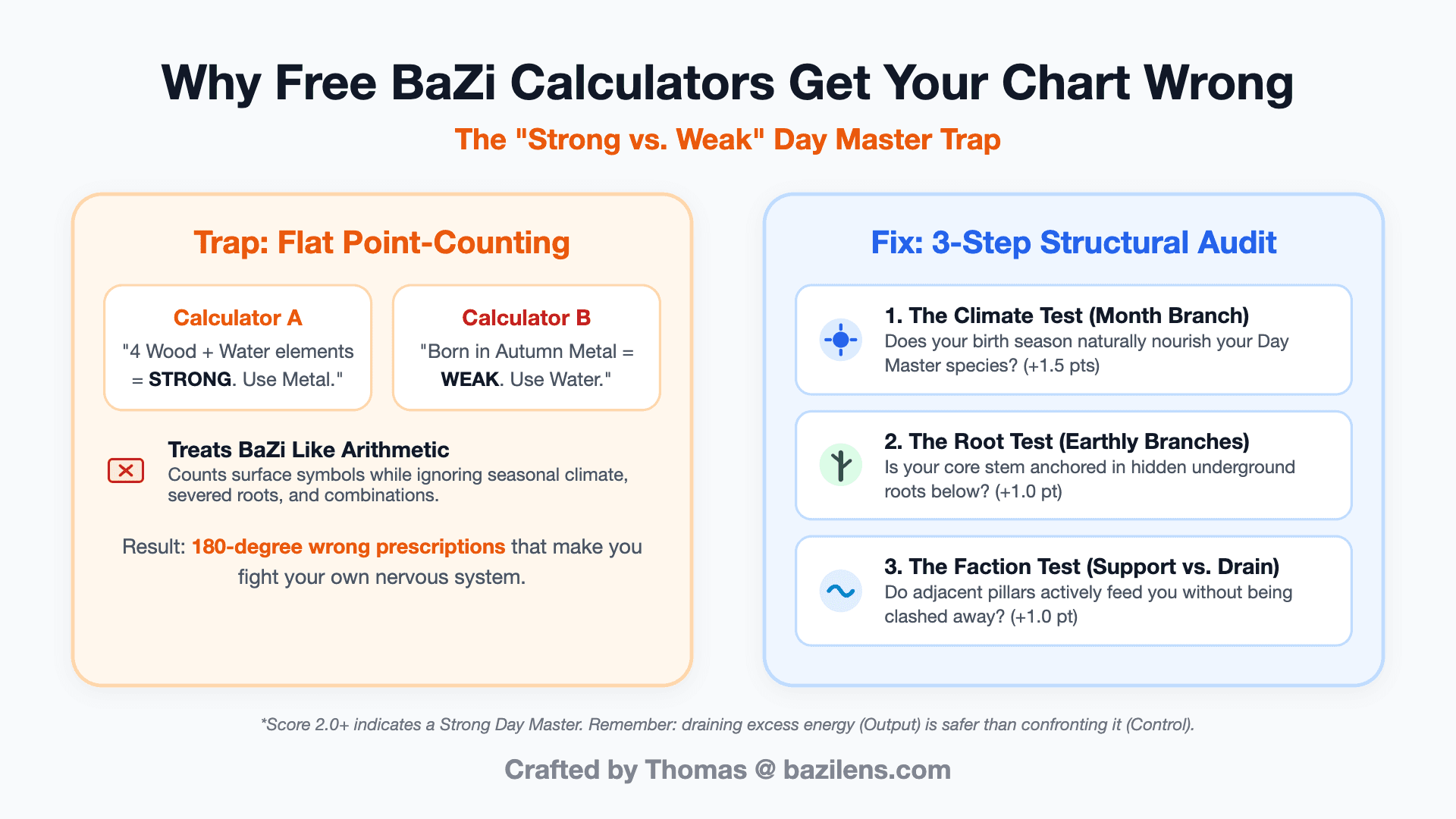
The Conflicting Calculator Nightmare
If you have ever tried to decode your own birth chart using free BaZi calculators online, you have likely run into a maddening contradiction.
You enter your exact birth date and time into Calculator A, and it declares that you are a "Weak Day Master" whose Favorable Element is Water. Five minutes later, you plug the exact same birth details into Calculator B, and it confidently tells you that you are a "Strong Day Master" who must avoid Water at all costs and lean into Fire instead. Then you try a third site, which labels you a rare "Follower Chart" and prescribes Metal.
In my community interactions, this is single-handedly the most common source of frustration I see. People arrive exhausted, staring at three conflicting pie charts, asking: "Which one is right? What is my actual Useful God, and why do these tools completely disagree on who I am?"
Here is the truth I discovered while building my own observational framework for BaziLens: most free online calculators get your Favorable Element wrong because they treat BaZi like basic first-grade arithmetic. They simply count how many times each element appears on the surface of your chart.
But BaZi is not a block-counting game. It is a living, breathing ecological system. Let’s break down why basic point-counting fails, what "Strong vs. Weak" actually means in classical structural analysis, and how you can manually verify your chart's true needs in three steps.
The 30-Second Breakdown
- ●The Core Flaw: Standard online calculators use flat percentage bars and rigid point addition, treating a winter spark and a summer wildfire as if they carry the exact same weight.
- ●The Ecological Reality: Your Month Branch (birth season) dictates the macro-climate of your entire chart. Three visible Water elements cannot save a Wood Day Master if that Water is frozen solid in winter or blocked by Earth combinations.
- ●The Structural Fix: Instead of counting surface symbols, evaluate your chart through three structural filters: The Climate Test (Month Branch), The Root Test (Hidden Stems in the Earthly Branches), and The Faction Test (Support vs. Drain).
- ●The Safety Rule: When balancing a genuinely Strong Day Master, draining excess energy through Output is almost always safer and more sustainable than controlling it through direct confrontation.
What ‘Strong’ and ‘Weak’ Actually Mean in Your Ecosystem
Before we look at why basic calculators fail, we need to strip away the ego attachment around the words "Strong" and "Weak."
Day Master Strength: In BaZi, Day Master strength is a structural measure of how heavily your core element is supported by your birth season and surrounding pillars, rather than a reflection of your personal willpower, physical vitality, or moral character.
Useful God (Yong Shen): In BaZi, the Useful God—often called your Favorable Element—is the specific elemental force that restores temperature, moisture, and structural equilibrium to your chart's ecosystem.
In our ecological model, a Strong Day Master simply means your core plant species is heavily supported by its immediate environment. Imagine a towering ancient oak tree (Jia Wood) growing in deep, damp rainforest soil with constant rainfall. Its roots are thick, its canopy is dense, and its growth is unchecked.
A Weak Day Master, by contrast, is like a delicate sapling planted on a dry, windswept mountain ridge. It is still a resilient, high-potential plant, but its surrounding terrain is taxing rather than nourishing.
[Deep Dive] Still feel unsettled by being labeled "Weak" or "Strong"? Read my foundational breakdown on The Truth About 'Strong' vs. 'Weak' Day Masters to see why some of the most driven executives operate on "Weak" charts.
Why does this distinction matter so much? Because of the Principle of Balance:
- ●If you are an overgrown forest (Strong Day Master): You do not need more rain (Water / Resource) or more competing trees (Wood / Companion). Adding more moisture to an already flooded forest causes root rot—which in real life manifests as overthinking, analysis paralysis, and stagnant momentum. Instead, you need Fire (sunlight and warmth to channel your wood into creative output) or carefully applied Metal (pruning shears to give your life structure).
- ●If you are a desert sapling (Weak Day Master): Taking heavy pruning shears (Metal / Power) to a young sapling will snap it in half. In daily life, that looks like taking on high-pressure corporate stress when your internal battery is already at 5%. You desperately need rain (Water / Resource) and sheltering canopy (Wood / Companion) so your roots can anchor first.
Misdiagnosing Strong vs. Weak isn't a minor technicality—it completely flips the prescription by 180 degrees.
Why Flat Point-Counting Calculators Fail: A Real Case Study
Recently, I spoke with a reader—let's call him Marcus—who was experiencing severe career burnout. Marcus is a Jia Wood (Yang Wood) Day Master. When he ran his chart through two popular free BaZi websites, both showed a colorful bar graph indicating plenty of Wood and Water. The automated readout told him: "Your Day Master is Strong. Avoid Water and Wood. Surround yourself with Metal (high pressure, strict structure, competitive finance roles)."
Taking that advice seriously, Marcus leaned harder into a rigid, high-stress corporate compliance role. Within eighteen months, his sleep collapsed, his anxiety spiked, and his creative drive flatlined.
When we looked at the actual architecture of his four pillars rather than a flat percentage bar, the error was immediately obvious.
1. They Ignore the Sovereign Climate (Month Branch)
Month Branch (Yue Ling): In BaZi, the Month Branch is the Earthly Branch of your birth month, which governs the seasonal temperature and holds roughly 40% to 50% of the weighting in determining your chart's strength.
Marcus had two Wood stems and two Water stems floating in his Heavenly Stems (the top row of the chart). A basic calculator simply counted four supportive elements out of eight and declared him "Strong."
However, Marcus was born in the month of the Rooster (You)—the absolute peak of Autumn, where pure, cutting Metal rules the climate. In autumn, trees naturally shed their leaves, sap retreats underground, and Wood is in its weakest seasonal state (known as the Dead or Declining phase of growth). Counting surface stems without weighting the birth season is like claiming a palm tree is thriving in Antarctica just because someone poured two buckets of water on it.
2. They Miss Rootless Stems and Severed Roots
In an ecosystem, a tree cannot survive on leaves alone; it requires deep roots anchored in the soil (Earthly Branches).
In Marcus's chart, his Wood elements sat entirely in the Heavenly Stems (the visible canopy) with zero supporting Wood roots in the Hidden Stems below. Worse, the single Water branch he relied on was sitting directly next to a heavy Earth pillar, creating a muddy dam that prevented the water from ever reaching his Day Master.
To a naive point-counter, "2 Wood + 2 Water = Strong." To an ecological diagnostic, Marcus was a rootless tree standing on metallic rock during an autumn gale. He wasn't Strong at all—he was a Weak Jia Wood surviving under immense Seven Killings (Metal) pressure. The moment he stopped forcing himself into rigid Metal environments and reintroduced Water (restorative boundaries, deep research, mentorship) and Wood (collaborative peers), his energy finally stabilized.
3. They Fail to Detect Elemental Combinations
Elements in a BaZi chart are not static statues sitting in separate rooms; they interact chemically. When two specific stems or branches sit side by side, they can fuse into an entirely different element through Six Harmonies or Three Harmonies.
A basic calculator might see a Wood element and an Earth element and count them separately. Yet under the right seasonal conditions, Yang Wood (Jia) and Yin Earth (Ji) combine and transform into heavy Earth. The element you thought was supporting you has just switched sides to drain you.
The 3-Step Manual Protocol to Audit Your Chart Strength
Instead of trusting a black-box percentage bar, you can run a remarkably accurate structural audit on your own chart in under two minutes by asking three questions in strict order:
Step 1: The Climate Test (Check Your Month Branch)
Look at the bottom character of your Month Pillar. Does the season of your birth naturally nourish or support your Day Master species?
- ●For Wood Day Masters: Spring (Tiger, Rabbit) and Winter (Pig, Rat) provide natural support.
- ●For Fire Day Masters: Summer (Snake, Horse) and Spring (Tiger, Rabbit) provide natural fuel.
- ●For Earth Day Masters: Late Summer transition months (Dragon, Goat, Dog, Ox) and Summer (Snake, Horse) fortify your ground.
- ●For Metal Day Masters: Autumn (Monkey, Rooster) and Earth months provide mineral density.
- ●For Water Day Masters: Winter (Pig, Rat) and Autumn (Monkey, Rooster) feed your current.
If your Month Branch supports your Day Master, give yourself +1.5 points (because climate carries the heaviest weight).
Step 2: The Root Test (Check Your Earthly Branches)
Look at the bottom row of your chart across all four pillars (Year, Month, Day, Hour), particularly your Day Branch right underneath you. Does your Day Master have actual roots of the same element—or the Resource element that produces you—anchored inside those branches?
A Heavenly Stem without a root in the Earthly Branches is like cut flowers in a vase: it looks vibrant on the surface, but it has no long-term stamina when a stressful year hits.
If your Day Master has at least one solid root in the Earthly Branches (especially in the Month or Day Branch), give yourself +1 point.
Step 3: The Faction Test (Count Unblocked Support vs. Drain)
Now look at the remaining characters surrounding your Day Master, especially the Month Stem, Day Branch, and Hour Stem (the three positions closest to you). Are the elements directly touching your Day Master feeding you (Resource and Companion), or are they pulling energy out of you (Output, Wealth, and Power)?
If the majority of the immediately adjacent positions actively feed your Day Master without being clashed away, give yourself +1 point.
Scoring Your Ecosystem
- ●2.0 to 3.5 points: Your Day Master is genuinely on the Strong side. Your ecosystem has abundant fuel and needs an outlet to express, build, and vent excess pressure.
- ●0 to 1.5 points: Your Day Master is likely on the Weak side. Your ecosystem runs best when you prioritize replenishment, strategic pacing, and supportive environments rather than brute-force confrontation.
(Note: At the extreme ends of the spectrum—0 points or 3.5 points with a unified elemental wave—a chart may qualify as a specialized Follower Structure, where the ecosystem surrenders entirely to the dominant force rather than fighting for balance.)
A Crucial Safety Rule: Why Draining Beats Controlling
Suppose you run the 3-Step Protocol above and confirm that you are a genuinely Strong Day Master. How should you balance your life?
Many traditional textbooks—and almost all automated calculators—will tell a Strong Day Master to seek their Controlling Element (the Officer / Power star). For example, if you are Strong Wood, they tell you to seek Metal (axes and pruning shears) to chop your wood down.
In my observational experience, Flow (Draining) is almost always safer than Confrontation (Controlling).
When you use Metal to control Strong Wood, you introduce direct structural collision into your nervous system. Yes, an axe can shape a timber beam, but it does so through impact and stress. If you use Fire (Output / Expression) instead, you naturally drain the excess Wood by burning it as fuel to warm the ecosystem.
- ●Controlling (Power/Officer): Forcing yourself into rigid rules, harsh external accountability, and high-pressure hierarchies to keep yourself in check.
- ●Draining (Output): Channeling your overflowing stamina into creation, writing, speaking, building projects, or physical movement.
Unless your chart specifically requires structural forging, venting excess energy through creative output will leave you fulfilled, whereas suppressing it through external control often triggers unnecessary friction.
[Deep Dive] Want to see how our custom structural framework weighs your Month Branch, Hidden Stems, and elemental combinations automatically? Run your free chart diagnostic on BaziLens to inspect your real elemental topology.
Thomas's Reflections on Building BaziLens
When I first started coding the analytical engine behind BaziLens, I understood why so many developers took the shortcut of simply counting the five elements and rendering a pretty bar chart. Writing code to add up eight characters takes ten minutes.
Writing a system that accurately weighs seasonal temperature, checks whether a stem's root has been compromised by a branch clash, evaluates hidden stem reservoirs, and distinguishes between a bruised Strong chart and a true Weak chart takes months of obsessive refinement.
Yet every time I talk to someone like Marcus—someone who spent years fighting their own nature because a five-second calculator misread their seasonal climate—I am reminded why precision matters. Your birth chart is not a parlor game of counting blocks. It is an architectural map of how your energy interacts with time and environment.
Frequently Asked Questions
Why do different BaZi calculators show different element percentages?
Different BaZi calculators show conflicting percentages because there is no single universal math formula for weighting Hidden Stems and seasonal strength. Basic calculators count each character as a flat 12.5%, while advanced frameworks weight the Month Branch up to 45% and adjust for elemental combinations and clashes.
When you see a pie chart online, ask whether that tool is merely counting visible symbols or actually calculating seasonal climate. A single Fire branch in the peak of Summer carries vastly more thermal force than three rootless Fire stems floating in the dead of Winter.
Can my Favorable Element (Useful God) change over time?
Yes, your practical Favorable Element can shift as you move through different 10-Year Luck Pillars. While your natal chart's baseline structure remains fixed, a decade of heavy Water or Fire weather can temporarily tip a balanced ecosystem into excess or deficiency, requiring a different balancing element for that decade.
Think of your natal chart as your vehicle and your 10-Year Luck Pillar as the terrain you are driving through. If a naturally warm engine drives into the Arctic for ten years, it suddenly needs insulation and heat rather than extra coolant.
Is it better to have a Strong or Weak Day Master in BaZi?
Neither a Strong nor a Weak Day Master is inherently better for success, wealth, or happiness. A Strong Day Master simply possesses high internal stamina that requires an active outlet, while a Weak Day Master excels at leveraging external networks, systems, and timing once properly supported.
Some of the most visionary founders and artists operate on Weak or Follower charts because their ecosystems are highly sensitive and responsive to external trends, whereas Strong charts often have to guard against stubbornness and solo overexertion.
Stop Guessing Your Useful God—Debug Your Real Ecosystem
If you are tired of staring at conflicting element bars and wondering whether you should be pushing harder or pulling back to recharge, stop relying on flat arithmetic.
When I built BaziLens, I designed the framework specifically to look past surface element counts and diagnose the actual seasonal climate, root strength, and structural flow of your Four Pillars. Let's stop guessing, and start debugging.
Related Insights
The Burnout Equation: Why Your BaZi Explains Your Current Exhaustion (And How to Fix It)
Discover why career burnout isn't a flaw in your work ethic, but a structural friction between your Core Engine (Day Master) and your 10-Year Luck Pillar.
Why High-Performers Burn Out: The Career Friction Between Output and Officer Energies
Discover why some high-performers feel hollow in corporate jobs. A deep dive into the BaZi dynamics of 'Output' energy versus strict 'Officer' structures.
The “Tai Sui” Myth: Why Your Zodiac Year Is Not Actually Cursed
Discover why your Chinese Zodiac year (Tai Sui) isn't a curse of bad luck, but rather an extreme amplification of your personal energy ecosystem.
Discussion
0No insights shared yet. Be the first to start the discussion!