Stop Trying to Memorize BaZi Jargon: Think of Your Astrological Chart as a Living Ecosystem Instead
Published on July 2, 2026•9 min read
The Jargon Trap
When I first started looking into Chinese metaphysics, I was completely overwhelmed by the vocabulary. "Hurting Officer"? "Rob Wealth"? "Friend"? "Void Emptiness"? It sounded like a badly translated fantasy novel. I spent my first year trying to rote-memorize hundreds of archaic terms, frantically googling definitions instead of actually understanding my life patterns.
If you are currently staring at a BaZi chart and feeling confused by what the animals, the "Gods," and the hidden stars actually do, you are not alone.
As a developer, I hate inefficient systems. Rote memorization is a low-leverage way to learn. When I set out to build BaziLens, my goal wasn't just to write code that calculates elements; it was to translate this ancient, complex framework into a clean, visual conceptual model that anyone can run.
The secret to understanding your chart isn't memorization. It is ecology. When you strip away the ancient cultural packaging, a BaZi chart is not a static list of fortunes or a mystical sentence of doom. It is a highly sophisticated, open-source conceptual model of natural energy dynamics.
Think of your chart as a topographical map of your personal ecosystem. Let's debug the terminology and map it to something you already understand: the natural world.
Your Topographical Map
To read a BaZi chart, you don't need to memorize ancient texts. You just need to look at it as a landscape and ask: What kind of terrain is this, and what kind of weather is hitting it?
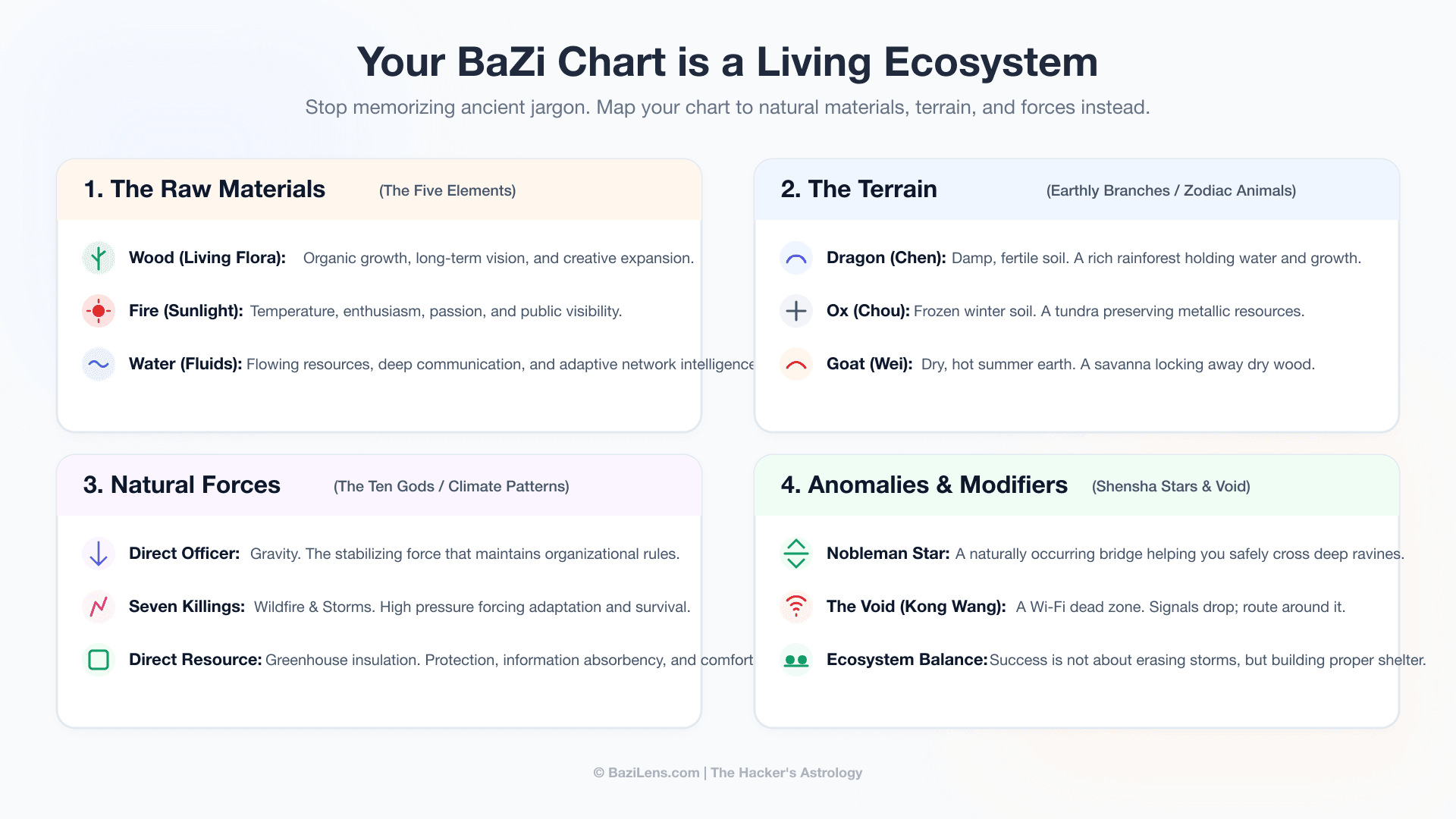
Here is how the core modules of the BaZi engine map to a living ecosystem:
+<span class="sentiment-negative font-bold text-[#dc2626]"></span><span class="sentiment-negative font-bold text-[#dc2626]"></span><span class="sentiment-negative font-bold text-[#dc2626]"></span><span class="sentiment-negative font-bold text-[#dc2626]"></span><span class="sentiment-negative font-bold text-[#dc2626]"></span><span class="sentiment-negative font-bold text-[#dc2626]"></span><span class="sentiment-negative font-bold text-[#dc2626]"></span><span class="sentiment-negative font-bold text-[#dc2626]"></span><span class="sentiment-negative font-bold text-[#dc2626]"></span><span class="sentiment-negative font-bold text-[#dc2626]"></span><span class="sentiment-negative font-bold text-[#dc2626]"></span><span class="sentiment-negative font-bold text-[#dc2626]"></span><span class="sentiment-negative font-bold text-[#dc2626]"></span><span class="sentiment-negative font-bold text-[#dc2626]"></span><span class="sentiment-negative font-bold text-[#dc2626]"></span><span class="sentiment-negative font-bold text-[#dc2626]"></span>-+
|                     YOUR LIVING ECOSYSTEM                       |
+<span class="sentiment-negative font-bold text-[#dc2626]"></span><span class="sentiment-negative font-bold text-[#dc2626]"></span><span class="sentiment-negative font-bold text-[#dc2626]"></span><span class="sentiment-negative font-bold text-[#dc2626]"></span><span class="sentiment-negative font-bold text-[#dc2626]"></span><span class="sentiment-negative font-bold text-[#dc2626]"></span><span class="sentiment-negative font-bold text-[#dc2626]"></span><span class="sentiment-negative font-bold text-[#dc2626]"></span><span class="sentiment-negative font-bold text-[#dc2626]"></span><span class="sentiment-negative font-bold text-[#dc2626]"></span><span class="sentiment-negative font-bold text-[#dc2626]"></span><span class="sentiment-negative font-bold text-[#dc2626]"></span><span class="sentiment-negative font-bold text-[#dc2626]"></span><span class="sentiment-negative font-bold text-[#dc2626]"></span><span class="sentiment-negative font-bold text-[#dc2626]"></span><span class="sentiment-negative font-bold text-[#dc2626]"></span>-+
|  1. THE FIVE ELEMENTS   |  Raw Materials (Soil, Water, Sun...)  |
|  2. EARTHLY BRANCHES    |  The Terrain (Rainforest, Tundra...)   |
|  3. THE TEN GODS        |  Natural Forces & Weather (Gravity...) |
|  4. SHENSHA (STARS)     |  Topographical Glitches & Shortcuts   |
|  5. THE VOID            |  Wi-Fi Dead Zones (Weak Signal)       |
+<span class="sentiment-negative font-bold text-[#dc2626]"></span><span class="sentiment-negative font-bold text-[#dc2626]"></span><span class="sentiment-negative font-bold text-[#dc2626]"></span><span class="sentiment-negative font-bold text-[#dc2626]"></span><span class="sentiment-negative font-bold text-[#dc2626]"></span><span class="sentiment-negative font-bold text-[#dc2626]"></span><span class="sentiment-negative font-bold text-[#dc2626]"></span><span class="sentiment-negative font-bold text-[#dc2626]"></span><span class="sentiment-negative font-bold text-[#dc2626]"></span><span class="sentiment-negative font-bold text-[#dc2626]"></span><span class="sentiment-negative font-bold text-[#dc2626]"></span><span class="sentiment-negative font-bold text-[#dc2626]"></span><span class="sentiment-negative font-bold text-[#dc2626]"></span><span class="sentiment-negative font-bold text-[#dc2626]"></span><span class="sentiment-negative font-bold text-[#dc2626]"></span><span class="sentiment-negative font-bold text-[#dc2626]"></span>-+
1. The Five Elements are Your Raw Materials
The Five Elements (Wood, Fire, Earth, Metal, Water) are your system's raw materials. They represent the fundamental building blocks of your landscape:
- ●Earth is the soil and structural foundation.
- ●Water is the fluid resources, flow, and communication.
- ●Fire is the sunlight, temperature, and passion.
- ●Metal is the minerals, raw tools, and boundaries.
- ●Wood is the living flora, growth, and vision.
Your element ratios define what materials you have to build with. A chart with high Metal and low Wood has plenty of structural tools but very little organic growth. A chart with high Fire and zero Water is a hot, dry desert waiting for a spark.
2. The Earthly Branches are Your Terrain
In popular culture, Chinese astrology is all about the Zodiac animals—the Tiger, the Dragon, the Horse. But in a professional BaZi chart, these animals (known as the Earthly Branches) are actually shorthand codes for specific terrains and seasonal environments:
- ●The Dragon (Chen) is not a mythical beast; it represents a damp, nutrient-rich rainforest (Earth holding Water and Wood).
- ●The Ox (Chou) is not a farm animal; it represents a frozen winter tundra (Earth holding cold Water and Metal).
- ●The Goat (Wei) is a dry, hot savanna (Earth holding Fire and Wood).
- ●The Tiger (Yin) is a spring forest bursting with new growth.
When you look at the animals in your pillars, you are mapping the environment where your life happens. Are you trying to grow crops in a swamp, or are you navigating a dry savanna? Knowing your terrain changes how you build.
3. The Ten Gods are the Natural Forces
The term "Ten Gods" is a legacy translation that causes endless confusion. These are not deities. They are the natural forces and weather patterns acting upon your terrain:
- ●Direct Officer is gravity. It is the stabilizing force that keeps things organized, sets boundaries, and prevents total chaos.
- ●Seven Killings is acute environmental pressure—like a severe storm, an avalanche, or a forest fire. Unchecked, it is destructive. But in ecology, fire is a vital mechanism for clearing dead wood and forcing adaptation.
- ●Direct Resource is insulation and nurturing—like rich soil or a protective greenhouse that feeds and shields you.
4. The Hidden Stars are Topographical Glitches and Shortcuts
This is where beginners get stuck. Take the Nobleman (Tian Yi Gui Ren) star. Traditional texts describe it as a helper who rescues you from danger.
In ecosystem terms, a Nobleman is a naturally occurring bridge over a deep ravine. It does not walk the path for you, but it makes crossing a dangerous gap significantly easier when you are stuck in harsh terrain. It is a structural shortcut built into your map.
5. The Void is a Wi-Fi Dead Zone
The concept of Void (Kong Wang) or "Emptiness" sounds terrifying—like a black hole swallowing your luck.
In topographical terms, the Void is simply a Wi-Fi dead zone in your ecosystem. The physical space still exists, but the signal transmission is weak. If your career pillar sits in a Void, it doesn't mean you cannot work. It just means you shouldn't build your main, mission-critical server on that specific plot of land, because the connection will keep dropping. You have to route your energy differently.
Real-World Examples
To see how this works in practice, let's look at two real-life cases from my recent discussions within the community. These examples show what happens when we stop looking at charts as lists of terms and start analyzing them as ecosystems.
Case Study 1: The Wildfire in the Dry Savanna
A community member reached out to me experiencing extreme, chronic burnout. They felt like every project they started ended in exhaustion, and their relationships were constantly volatile. They looked at their chart, saw a massive amount of the Seven Killings force rooted in a Goat terrain, and assumed their destiny was cursed.
Let's translate their chart into an ecosystem map:
- ●Goat (Wei) Terrain: A dry, hot, highly combustible savanna.
- ●Seven Killings: Option for volatile energy.
In ecological terms, this chart represents a massive wildfire sweeping through dry brush. It is a high-friction, deeply exhausting environment. Because the chart had zero Water elements, there was no natural cooling mechanism to contain the heat. The system was constantly burning itself down.
The solution wasn't to fight the fire or panic about "Seven Killings." The solution was to introduce Direct Resource (insulation/support) and Water (cooling flow). In practical terms, we advised this user to:
- Establish strict "cool-down" boundaries (no screen time after 8 PM, regular nature walks to introduce grounding).
- Shift their work model from high-adrenaline, short-term launch cycles to a highly structured, insulated consultancy role where they were protected from direct operational crises.
Instead of letting the wildfire consume them, they channeled the heat. They used the high temperature to fire a kiln and forge resilient, long-term assets. Their burnout resolved because they stopped fighting the weather and built the right shelter for their terrain.
Case Study 2: Re-routing the Wi-Fi Dead Zone
Another client was struggling to establish a stable career. Despite having excellent qualifications and a dominant Indirect Wealth (Entrepreneurial) force in their chart, every business they launched seemed to lose momentum and dissolve into thin air. They felt like they were shouting into a void.
When we ran their matrix through my framework, the diagnostic was clear: their career pillar was located in the Void (Emptiness) zone of their chart.
In traditional astrology, this is often interpreted as "you have no career luck." But in ecosystem terms, they were simply trying to run a high-bandwidth online business from a Wi-Fi dead zone. The signal was constantly dropping.
Instead of telling them to give up on entrepreneurship, we looked at the rest of their terrain. Their day pillar had "full bars" of connectivity, supported by a strong Collaborator (Friend) force.
We advised them to pivot their business model:
- ●Stop trying to build a solo brand from scratch (which relied heavily on the dead-zone pillar).
- ●Partner with an established co-founder whose chart had strong, active career pillars, and act as the internal operations architect (leveraging their strong day pillar).
By routing their entrepreneurial energy through an ally's infrastructure, they bypassed the dead zone. The business succeeded because they stopped trying to force a signal where there was no coverage and built their transmitter on solid ground.
Practical Adjustments
Your BaZi chart is not a static sentence; it is a dynamic landscape. If you want to start navigating your chart like an engineer rather than a spectator, follow these steps:
Step 1: Identify Your Terrain
Look at your Earthly Branches (the animals). Are they wet, dry, cold, or hot?
- ●If your chart is dominated by Ox (Chou) and Rat (Zi), you are operating in a cold, dark, winter environment. You need Fire (warmth, visibility, expression) to get things moving.
- ●If your chart is dominated by Snake (Si) and Goat (Wei), you have a hot, dry environment. You need Water (reflection, fluid boundaries, recovery) to prevent fires.
Step 2: Stop Fighting the Weather
If you see a lot of Seven Killings (storms) in your chart, stop trying to picnic. Accept that your landscape experiences high pressure. Build storm-shelter systems: automate your operations, keep large financial reserves, and design your lifestyle to absorb sudden shocks.
Step 3: Map Your Dead Zones
Find where your Void sits. If it is in your social pillar, do not rely on massive public networking to build your business. If it is in your resource pillar, accept that traditional schooling or institutional support might not flow easily to you. Route your path around these dead zones.
Building BaziLens
When I was writing the calculation engine for BaziLens, my goal was to make these ecological patterns instantly visible. Traditional calculators just throw Chinese characters and literal translations at you. I wanted to build a UI that shows you the temperature, the moisture, the structural forces, and the bridges in your chart at a glance.
If you are tired of memorizing archaic terms and want to see the actual map of your personal ecosystem, let's stop guessing and start debugging.
You can run your complete matrix and get a high-resolution diagnostic of your element balances, terrain structures, and natural forces at BaziLens.
Stop trying to change the climate you were born with. Learn to build the right architecture for your specific terrain.
Analyzed by Thomas | Date: 2026-07-02
Related Insights
The Burnout Equation: Why Your BaZi Explains Your Current Exhaustion (And How to Fix It)
Discover why career burnout isn't a flaw in your work ethic, but a structural friction between your Core Engine (Day Master) and your 10-Year Luck Pillar.
Why High-Performers Burn Out: The Career Friction Between Output and Officer Energies
Discover why some high-performers feel hollow in corporate jobs. A deep dive into the BaZi dynamics of 'Output' energy versus strict 'Officer' structures.
The “Tai Sui” Myth: Why Your Zodiac Year Is Not Actually Cursed
Discover why your Chinese Zodiac year (Tai Sui) isn't a curse of bad luck, but rather an extreme amplification of your personal energy ecosystem.
Discussion
0No insights shared yet. Be the first to start the discussion!