Why Too Much 'Fire' Isn't a Superpower: The Five Elements Feedback Loops
Published on July 2, 2026•6 min read
Introduction
When people first discover the 4x2 matrix of their birth chart, they often look for their dominant element. A common reaction is: "I have so much Fire in my chart, I must be super powerful and energetic!"
I see this all the time in the community. We are naturally conditioned to think that "more" equals "better." But in the architectural system of Chinese Metaphysics, having an overwhelming amount of one element isn't a superpower—it's an imbalance. And imbalances lead to burnout, stagnation, or systemic crashes.
Today, we are going to look at the energy that runs your personal operating system: The Five Elements (Wu Xing). More importantly, we are going to explore the feedback loops that regulate them, because you cannot fix an imbalance without understanding how your energy flows.
The Core Concept
In the BaZi framework, the Five Elements (Wood, Fire, Earth, Metal, Water) are not static objects. They are phases of energy that constantly interact with one another through specific feedback loops.
1. The Generating Cycle: The Natural Support
The Generating Cycle is a cooperative loop where one element naturally feeds, supports, and nurtures the next. Think of it like a natural ecosystem where one phase of energy seamlessly transforms into another:
- ●Wood feeds Fire: Just like logs feed a campfire. In your personality, this is when your ideas and vision (Wood) fuel your passion and action (Fire).
- ●Fire feeds Earth: Fire burns matter into ash, which becomes soil. This is where your expressive passion (Fire) settles down and solidifies into stable, practical habits (Earth).
- ●Earth feeds Metal: Metal ores are mined from deep within the earth. This is when your grounded stability (Earth) allows you to refine your thoughts and build structured discipline (Metal).
- ●Metal feeds Water: Metal condenses moisture into water, or melts into liquid. This is where structure and boundaries (Metal) dissolve into fluid wisdom and deep intuition (Water).
- ●Water feeds Wood: Water nourishes seeds to grow into trees. This is when your quiet reflection and intuition (Water) spark the growth of new visions and plans (Wood).
If your chart has a smooth chain of elements generating one another, your energy flows effortlessly. But what happens when there is no regulation? If you have massive Wood feeding Fire, but nothing to regulate the Fire, it will simply burn out of control until you crash.
2. The Controlling Cycle: The Natural Regulator
Most traditional texts translate this cycle as "destruction" or "conquering." This makes it sound like a battle where elements are trying to kill each other, which is a dangerous misconception.
Instead of destruction, think of the Controlling Cycle as a natural cooling system or a regulatory buffer. It is the system that keeps your elements in check, preventing them from burning out or stagnating:
- ●Wood controls Earth: Tree roots bind the soil to prevent mudslides. Earth (groundedness/stability) can easily turn into heavy stagnation or stubborn quicksand. Wood (growth/movement) breaks up the Earth, forcing you to take action instead of overthinking.
- ●Earth controls Water: A dam contains a wild river. Water (intuition/emotions) needs Earth (logic/routine) to build a container. Without Earth, Water flows everywhere, leaving you emotionally adrift and scattered. Earth keeps Water focused and useful.
- ●Water controls Fire: This is your cooling system. Having massive Fire (passion/output) without Water (reflection/cooling) is like running a car engine without coolant—you will overheat. Water regulates Fire so it doesn't lead to chronic anxiety and burnout.
- ●Fire controls Metal: Fire melts raw ore to forge tools. Metal (rigidity/discipline) needs Fire (warmth/passion) to soften it. Without Fire, Metal becomes cold, unyielding, and hyper-critical. Fire makes it adaptable.
- ●Metal controls Wood: An axe prunes a tree. Wood (boundless ambition/vision) needs Metal (boundaries/structure) to stay focused. Without Metal, Wood grows wild and scattered, starting a dozen projects and finishing none. Metal shapes Wood into a functional structure.
Real-World Examples
Recently, an insightful user asked me a question that perfectly highlights why these cycles matter. They were curious about the concept of "Day Master Strength" and "Favorable Elements" (also known as Useful Gods).
This user realized that knowing your dominant element isn't enough; you need to know your system's bandwidth.
Think of your Day Master Strength as your energy's battery capacity.
If you have a Strong Day Master, you have a massive battery. You can handle immense pressure and manage complex projects. But if you lack a creative outlet (an element to drain the excess energy), you become restless and explosive.
If you have a Weak Day Master, your battery drains faster. You need to recharge frequently through learning, support, and community before you tackle big challenges.
This is where the "Useful God" comes in. The Useful God is essentially the specific medicine your chart needs to achieve equilibrium based on these feedback loops.
Practical Adjustments
The biggest mistake people make when trying to balance their chart is assuming they should always use the Controlling Cycle to fix an extreme imbalance.
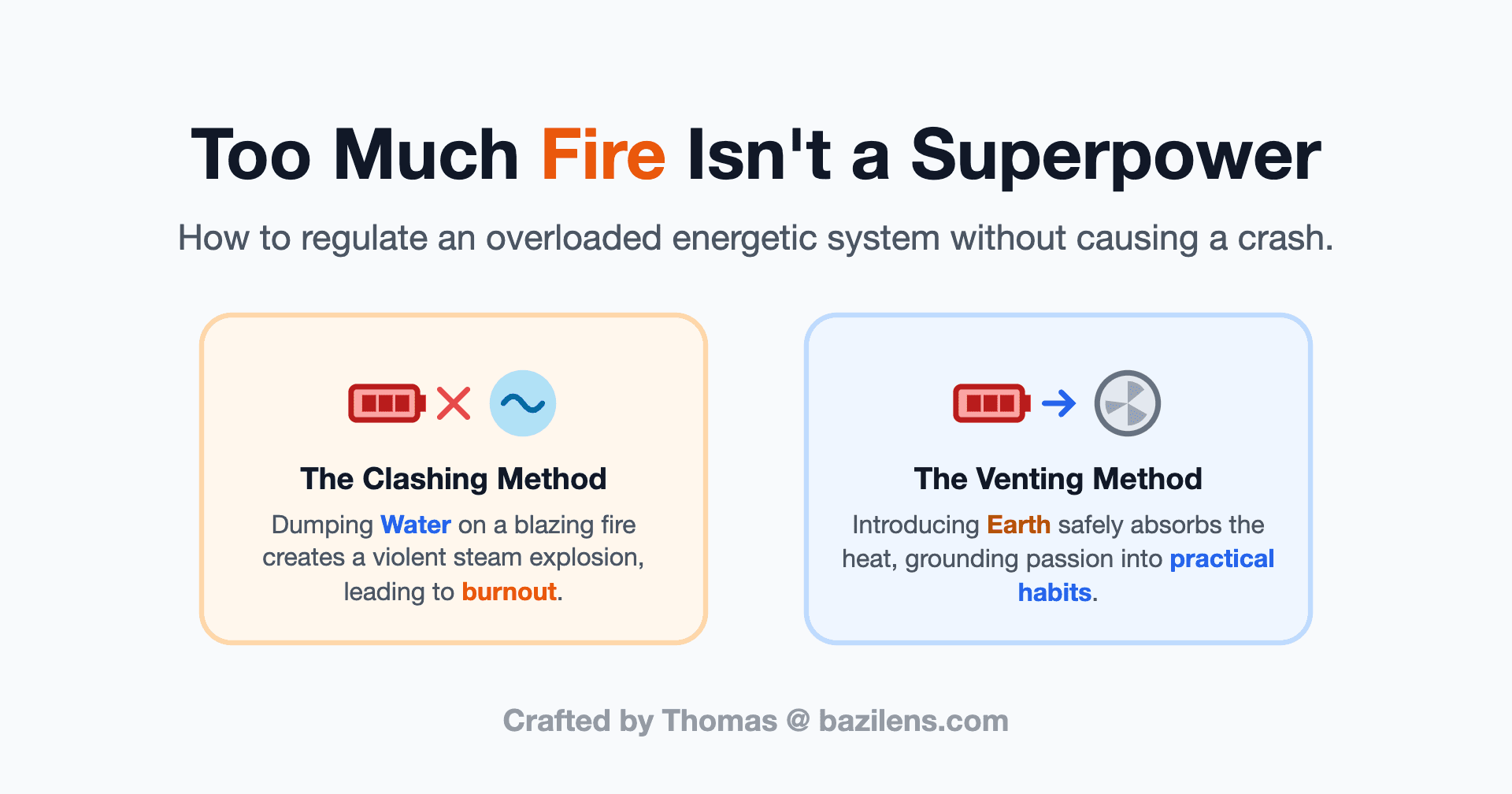
If someone sees they have a blazing hot Fire system, their first instinct is often: "I need to dump Water on it."
But in a real physical system, dumping cold water on a blazing furnace doesn't safely cool it down—it creates a violent steam explosion.
The Cheat Code: Regulation vs. Combustion
When an element is overwhelmingly dominant, directly clashing with it can backfire. Instead, you need to bleed off the excess energy using the Generating Cycle.
If your Fire is running dangerously hot, the safest way to regulate it is to introduce Earth. Earth absorbs the heat of the Fire and safely transforms it into useful, grounded action. You let the fire burn, but you direct it into the ground.
- Map Your Ecosystem: Look at the distribution of the Five Elements in your chart. Which element is dominant?
- Identify Your Regulators: Are you relying on the Controlling Cycle (clashing) or the Generating Cycle (venting) to manage your stress?
- Apply the Right Medicine: If you feel burnt out (too much Fire), don't force yourself into cold, rigid isolation (Water). Instead, ground yourself with practical, routine tasks (Earth).
Final Thoughts
What I love about this framework is how perfectly it maps to systems engineering. You wouldn't build a high-performance server without a heat sink, and you shouldn't try to run your life without understanding your own regulatory buffers. The Five Elements aren't mystical forces; they are a diagnostic tool for your personal energy grid.
Optimize Your Energy Grid
Your birth chart is essentially a map of your personal ecosystem. Some parts of your system will be highly active, while other parts will need conscious regulation to stay in balance.
Stop guessing which elements are driving you to burnout. Let's debug your chart and find the exact feedback loop you need to thrive.
Related Insights
The Burnout Equation: Why Your BaZi Explains Your Current Exhaustion (And How to Fix It)
Discover why career burnout isn't a flaw in your work ethic, but a structural friction between your Core Engine (Day Master) and your 10-Year Luck Pillar.
Why High-Performers Burn Out: The Career Friction Between Output and Officer Energies
Discover why some high-performers feel hollow in corporate jobs. A deep dive into the BaZi dynamics of 'Output' energy versus strict 'Officer' structures.
The “Tai Sui” Myth: Why Your Zodiac Year Is Not Actually Cursed
Discover why your Chinese Zodiac year (Tai Sui) isn't a curse of bad luck, but rather an extreme amplification of your personal energy ecosystem.
Discussion
0No insights shared yet. Be the first to start the discussion!