Why Yin Earth and Yin Fire Over-Give in Relationships
Published on November 14, 2026•11 min read
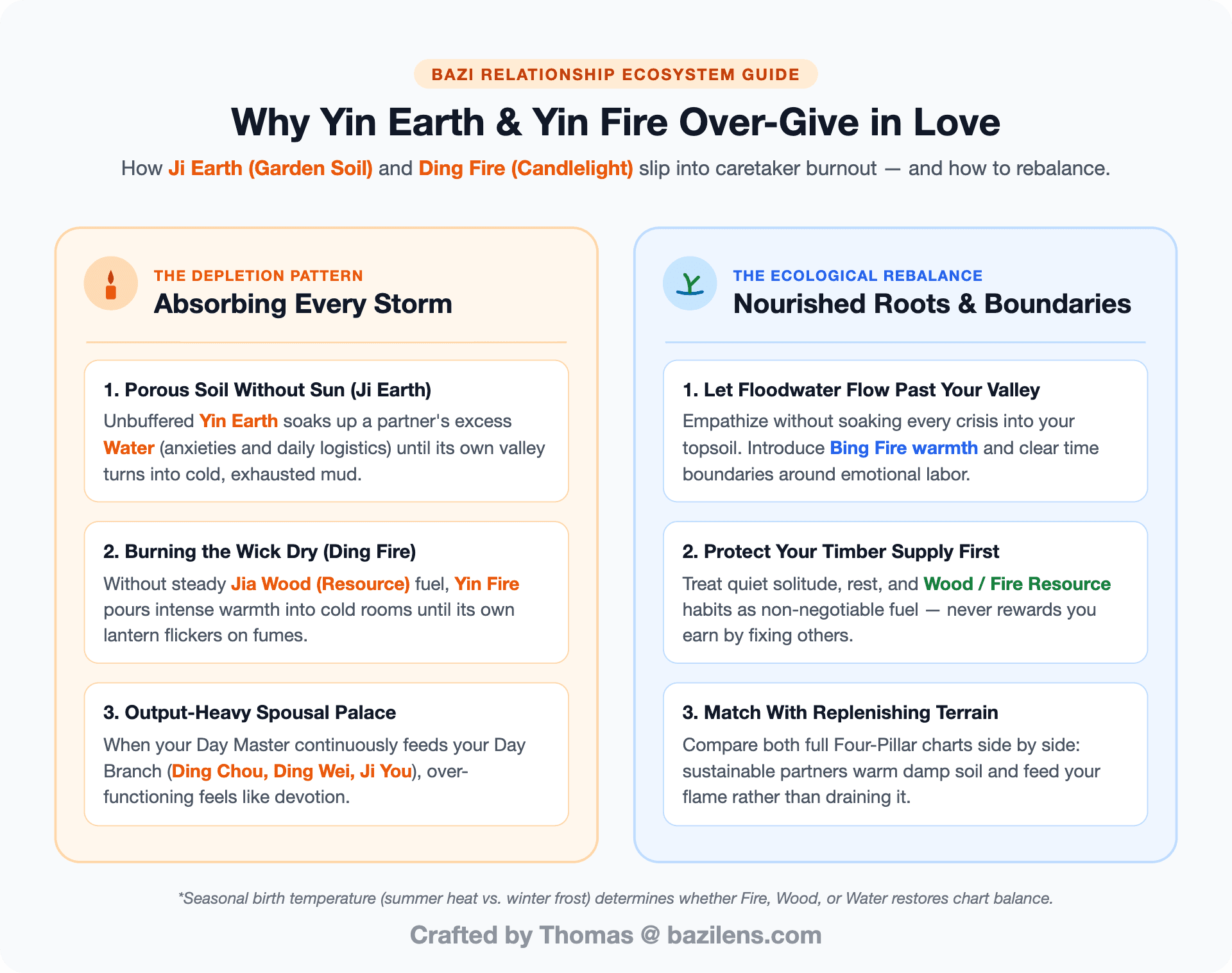
After mapping hundreds of relationship charts over the past year, one pattern stood out so sharply that I had to pause and double-check my notes. Whenever someone wrote in asking why they always end up playing therapist, emotional anchor, and crisis manager for partners who struggle to reciprocate, two Day Masters appeared again and again: Yin Earth (Ji Earth) and Yin Fire (Ding Fire).
On the surface, these two archetypes look resilient, warm, and endlessly patient. Friends describe them as the safe harbor in every group—the ones who remember how you take your tea, sense tension before a word is spoken, and hold a household together during chaotic seasons. Yet behind closed doors, many Ji Earth and Ding Fire individuals quietly hit a wall of profound resentment and exhaustion, wondering why loving someone so deeply leaves their own inner landscape completely depleted.
In classical Four Pillars of Destiny (BaZi), chronic over-giving is rarely a random personality quirk. It is an ecological imbalance between your Day Master, your Output Elements, and the specific terrain sitting inside your Spousal Palace.
The 30-Second Breakdown
- ●Ji Earth (Garden Soil) absorbs by design: Without firm mineral boundaries (Metal) or warming sunlight (Bing Fire), Yin Earth naturally soaks up a partner's emotional storms until its own soil becomes waterlogged and heavy.
- ●Ding Fire (Candlelight) burns itself to warm the room: When Yin Fire lacks steady dry timber (Jia Wood) or pours too much warmth into heavy Earth (Output), it consumes its own wick trying to guide lost or distant partners.
- ●Your Spousal Palace dictates intimate reciprocity: The Earthly Branch directly beneath your Day Master reveals whether your closest partnership nourishes your roots or quietly drains your reserves every day.
- ●Healthy love requires ecological drainage and boundaries, not self-erasure: Compatibility improves dramatically when you pair with a chart that replenishes your depleted element rather than demanding endless caretaking.
The Metaphysics Concept Explained: Garden Soil, Starlight, and the Spousal Palace
To understand why caretaker burnout hits these two Day Masters harder than any others, we have to step away from generic zodiac horoscopes and examine how their living ecosystems behave in close proximity to another person.
Ji Earth (Yin Earth Day Master): In BaZi, Ji Earth represents fertile, cultivated garden topsoil, valley loam, and nurturing farmland. Unlike Wu Earth—which stands like an immovable granite mountain that deflects wind and rain—Ji Earth is soft, porous, and receptive. Its natural gift is turning raw seeds, fallen leaves, and rainwater into thriving orchards. However, because fertile soil yields to whatever lands upon it, an unguarded Ji Earth chart absorbs every drop of a partner's anxiety (excess Water) or lets demanding roots (unchecked Wood) tear up its quiet valley without protest.
Ding Fire (Yin Fire Day Master): In BaZi, Ding Fire represents focused warmth—starlight in a dark sky, a hearth fire in winter, or a steady lantern flame. Unlike Bing Fire (the blazing midday sun that shines indiscriminately across the entire sky and disappears at dusk), Ding Fire stays awake in the dark, focusing intense warmth on one room, one cause, or one beloved person. Yet a lantern flame is finite: without dry Jia Wood timber feeding it steadily, pouring endless heat into cold earth (Output) leaves Ding Fire flickering on fumes.
Spousal Palace (Day Branch): In BaZi, the Spousal Palace is the Earthly Branch sitting directly beneath your Day Master in the Day Pillar, representing the private plot of land where your closest romantic bond lives. While your Year and Month Pillars reflect your public life at the forest's edge, the Day Branch governs daily domestic intimacy—showing both the type of partner you instinctively invite in and how you behave once the door closes.
[Deep Dive] If you have ever wondered why an initially magnetic partner suddenly retreats into icy silence when things get serious, read our companion analysis on Why Your Ex Pulls Away: The BaZi Code Behind Relationship Burnout.
When a Ji Earth or Ding Fire Day Master sits atop an Output branch—such as Ding Chou (a lantern resting on frozen winter mud), Ding Wei (a flame warming parched summer soil), Ji You (garden soil compressing itself into delicate crystal), or Ji Si / Ding Si—caretaking is wired directly into the foundation of intimacy. Notice the directional flow: when your Day Master produces your Day Branch (Day Master feeds Spousal Palace), your instinctive love language is giving, soothing, and accommodating. When your Day Branch produces your Day Master (Spousal Palace feeds Day Master, such as Ji Si or Ding Mao), you naturally crave emotional sanctuary at home—and suffer deeply if a partner brings turbulent storms onto that ground instead.
The Real-Life Case Study: When Garden Soil Meets a Flooding River
Let us look at a composite, anonymized pair I analyzed recently—a woman we will call Claire, living in Honolulu, and her long-term partner, Marcus.
Claire is a Ji Earth Day Master born in a damp late-autumn Water Dog (Ren Xu) season, sitting on a Ji Hai (Yin Earth over Pig) Day Pillar, with Xin Metal (Eating God) gleaming in her Hour Stem. Marcus is a Strong Ren Water (Yang Water) Day Master born in mid-winter, carrying heavy Water and Wood across his chart and almost zero Fire.
When they first met, their chemistry felt effortless:
- Why Marcus Felt Drawn to Claire: As a roaring winter Ren Water river lacking warmth (0% Fire), Marcus felt constantly restless and unanchored. Claire's Ji Earth garden valley and soft Xin Metal output felt soothing, non-judgmental, and grounding. For the first time in his life, someone listened without trying to cage his momentum.
- Why Claire Quietly Drowned Over Three Years: Look closely at Claire's natal ecosystem. Beneath her Ji Earth Day Master sits Hai (the Pig)—a turbulent underground river holding Ren Water (Direct Wealth) and Jia Wood (Direct Officer) inside her Spousal Palace. In a dry summer chart, that underground stream would keep her garden lush. Born in chilly late autumn, however, Claire's soil was already cool and damp. Adding Marcus's massive winter Ren Water river flooded her valley completely.
- The Caretaker Trap in Motion: In ecological terms, Water is Wealth to Earth (practical logistics, tangible responsibilities, managing outcomes), and Wood is Power/Officer (pressure, expectations, self-discipline). Whenever Marcus felt overwhelmed in his career, his rushing Water poured straight into Claire's chart—turning into household logistics she felt obligated to manage, schedules she quietly fixed, and emotional tension she absorbed through her Xin Metal output. Without Bing Fire (the Sun) between them to warm the sodden soil and evaporate the excess floodwater, Claire turned into cold mud: exhausted, resentful, and invisible in her own relationship.
How Their Dynamic Shifted Once Mapped
Neither Claire nor Marcus was a "bad partner," and their charts were not cursed. Their ecosystems simply lacked a solar bridge. Once Claire saw why her Ji Hai structure instinctively soaked up Marcus's winter storms, she stopped treating self-sacrifice as proof of devotion. Instead of channeling her energy into endless Metal problem-solving (which drained her Earth even further), she introduced Fire habits—warm, unapologetic self-nourishment, clear time boundaries around Marcus's work crises, and asking Marcus to channel his strong Wood energy into building tangible shared structure rather than leaning on her emotional labor.
[Deep Dive] Curious whether your partner's chart warms your ecosystem or floods your Spousal Palace? Compare both birth charts side by side using the BaziLens Relationship Compatibility Analyzer to see your exact five-element interplay.
Actionable Rebalancing Protocol: Three Shifts for Ji Earth and Ding Fire
If you recognize yourself in the caretaker cycle—whether you are currently in a long-term partnership or healing before your next relationship—use these three ecological adjustments to protect your core vitality:
- Stop Confusing 'Absorbing' With 'Connecting' (For Ji Earth): Fertile garden soil thrives when watered in moderation and warmed by morning sun (Bing Fire). When a partner vents or spirals, notice the urge to immediately hold, organize, and solve their discomfort. Practice letting water flow past your valley instead of soaking every drop into your topsoil. Ask yourself: "Am I nourishing a shared garden right now, or am I letting my boundaries wash away?"
- Protect Your Timber Supply Before Lighting Someone Else's Path (For Ding Fire): A hearth fire cannot warm a winter cabin if nobody brings dry firewood (Jia Wood / Resource) indoors. Ding Fire individuals often feel guilty taking quiet, unstructured solo time to read, rest, or receive care without earning it first. Treat your Resource element—solitude, deep study, mentorship, and unhurried sleep—as non-negotiable fuel, never an indulgence.
- Audit the Directional Flow of Potential Partners Early: When dating or evaluating a serious bond, pay attention to what your body feels two hours after spending time together. Does this person bring Sunlight (Fire) to warm damp soil or Steady Timber (Wood) to sustain your flame? Or do they arrive like a sudden flash flood (excess Water) or heavy, damp clay (excess Output drain) that leaves you needing three days of silence to recover?
My Reflections on Building BaziLens
When I designed the relationship modules inside the BaziLens diagnostic framework, I deliberately refused to reduce human love to a single percentage score based on birth-year animals. Telling a Horse and a Rat that they "clash," or telling a Rabbit and a Dog that they are "soulmates," completely ignores what happens in the private grove of the Day Pillar.
Some of the most tender, enduring partnerships I have studied involve two charts that look mismatched on the surface, yet thrive because both partners understand their elemental appetites. Being Ji Earth or Ding Fire is an extraordinary gift—the world desperately needs people who know how to cultivate life and hold steady warmth in the dark. The secret is remembering that a garden needs sunlight of its own, and even the brightest starlight needs a quiet night sky to shine.
Frequently Asked Questions
Are Ji Earth and Ding Fire compatible with each other in BaZi?
Yes, Ji Earth and Ding Fire often share a naturally warm, deeply supportive bond when seasonal temperatures are balanced. In the five-element cycle, Ding Fire nourishes Ji Earth like gentle hearth warmth enriching garden soil, creating strong emotional intuition and mutual loyalty.
However, if both charts are born in scorching summer months (
Si, Wu, or Wei) with zero Water, their combined warmth can parch the soil. In dry charts, both partners need healthy Water and Metal outlets—shared curiosity, travel, and breathing room—so closeness does not turn into shared anxiety.Why do I keep attracting partners who need fixing according to my BaZi chart?
Attracting partners who lean heavily on your caretaking usually stems from an Output-heavy Spousal Palace or unbuffered Resource empathy. When your Day Master continuously feeds your Day Branch (such as Ding Chou, Ding Wei, or Ji You), over-functioning feels familiar and safe.
Similarly, if your chart holds strong Water or Wood pressure inside the Day Branch without a supportive Resource element, you may mistake high emotional urgency for romantic chemistry. Recognizing this pattern lets you consciously choose partners who bring nourishing Resource energy instead.
What is the best partner element for a Weak Ding Fire or Weak Ji Earth Day Master?
A Weak Ding Fire Day Master thrives best with partners rich in Wood (Resource) and balanced Fire, while a Weak Ji Earth Day Master flourishes alongside warm Fire (Resource) and grounded Earth. These elements replenish your core reserves rather than demanding constant emotional output.
That said, overall chart climate always overrides simple labels. Even a Strong Ji Earth born in freezing winter desperately welcomes Bing Fire warmth, which is why checking exact birth times and seasonal branches for both partners is essential before judging compatibility.
See How Two Ecosystems Actually Interact Beneath the Surface
If you are tired of guessing why certain relationships feel effortlessly restorative while others leave you emotionally hollowed out, look directly at the architecture of both Day Pillars.
Run a side-by-side elemental pairing in the BaziLens Relationship Compatibility Analyzer, or map your own True Solar Time Spousal Palace and 24-Month Relationship Windows in the [BaziLens Chart Calculator] to build bonds that nourish your roots instead of draining them.
Related Insights
True Solar Time in BaZi: Why Clock Time Shifts Your Chart
Born in Singapore, Vancouver, Honolulu, or the US? Learn how political time zones and Daylight Saving Time shift your BaZi Hour and Day Pillars by 60+ mins.
Told You Have 'Hurting Officer' as a Woman? BaZi Truth
Told that Hurting Officer or Seven Killings ruins marriage in a woman's BaZi chart? Discover why old Imperial rules misread modern autonomy and love.
Am I Doomed With a 'Weak' Day Master? The Truth About 'Unfavorable' Luck Pillars
Terrified by a 'Weak' Day Master or 'no favorable Luck Pillars'? Learn how True Solar Time and split-element decades really work in BaZi.
Discussion
0No insights shared yet. Be the first to start the discussion!