2027 Fire Goat Year (Ding Wei): Why Your Birth-Year Animal Isn’t Enough
Published on October 22, 2026•13 min read
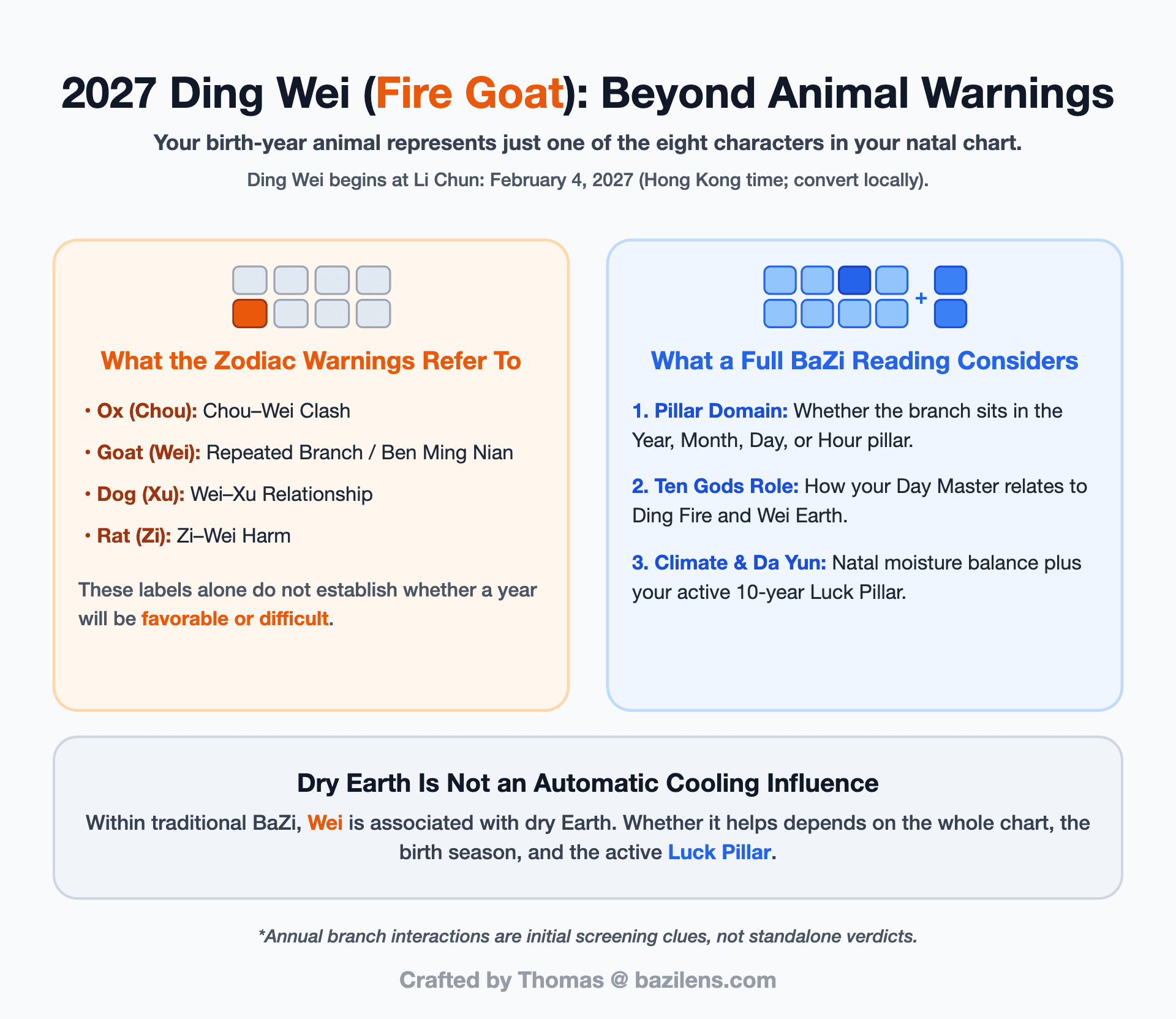
Why Annual Zodiac Warning Lists Cause Unnecessary Worry
As we head toward the end of the year, 2027 forecasts are already circulating online. Right on schedule, anyone born in the year of the Ox, Goat, Dog, or Rat is being warned to brace for trouble because 2027 is the Year of the Fire Goat (Ding Wei).
In our community discussions, this is one of the most common sources of unnecessary worry: seeing your birth-year animal on a "warned" list and assuming the entire year has already been decided against you.
While building and refining the observational framework behind BaziLens, I have watched hundreds of readers panic over single-character zodiac lists before ever looking at the rest of their birth chart. That surface-level shortcut misses how classical BaZi (Four Pillars of Destiny) actually works. Your birth-year animal is only the Year Branch—just one character out of eight in your natal chart.
Even before looking at branch interactions, calendar boundaries matter. In most BaZi lineages, the Ding Wei annual pillar begins at Li Chun (Start of Spring) on February 4, 2027 (based on Hong Kong / China Standard Time; convert to your local time zone), whereas the popular Lunar New Year falls on February 6, 2027—and neither begins on January 1. More importantly, you cannot judge an annual pillar from your birth year alone. A responsible reading evaluates how Ding Wei interacts with your Day Master, your Month Branch (birth season climate), the specific pillar where a branch interaction occurs, and your active 10-year Luck Pillar (Da Yun).
The 30-Second Breakdown
- ●The Calendar Boundary: In standard solar-based BaZi systems, the 2027 Ding Wei (Fire Goat) pillar begins at Li Chun on February 4, 2027 (Hong Kong / China Standard Time; convert locally), while Lunar New Year falls on February 6, 2027.
- ●The 1-of-8 Reality: Your birth-year zodiac animal is only the Year Branch (one of eight characters). Whether an annual Ox, Goat, Dog, or Rat interaction is challenging or constructive cannot be established from the birth year alone.
- ●Dry Earth Mechanics: Within traditional BaZi, Wei (Goat) is classified as dry late-summer Earth and the storage branch for Wood. In an already hot, parched chart, dry Earth does not automatically act as a cooling buffer.
- ●Whole-Chart Context: A complete reading weighs your Day Master’s Ten Gods relationship to Ding Fire and Wei Earth, your natal moisture balance, which pillar holds an interacting branch, and your active 10-year Luck Pillar.
Core BaZi Concepts Behind the 2027 Shift
Ding Wei (Fire Goat): In BaZi, Ding Wei is the 44th pillar of the sexagenary cycle, pairing Ding (Yin Fire) on the Heavenly Stem with Wei (Goat)—a dry late-summer Earth branch carrying hidden Ji Earth, Ding Fire, and Yi Wood—on the Earthly Branch.
Li Chun (Start of Spring): In BaZi, Li Chun is the first solar term of the agricultural year (occurring around February 4) that marks the transition from one annual pillar to the next in classical solar-calendar calculations.
Damp vs. Dry Earth Branches: In BaZi, the four Earthly Branches of Earth are divided by moisture and seasonal function into damp Earth (Chou and Chen) and dry Earth (Wei and Xu), which behave differently when interacting with Fire, Metal, and Water.
Comparing 2026 Bing Wu and 2027 Ding Wei: Why Dry Earth Is Not an Automatic Coolant
To compare the two annual pillars symbolically—not as literal weather or a universal psychological script that everyone will experience the same way—2026 (Bing Wu) pairs Yang Fire over Horse Fire, a traditional image of bright, outward heat. For charts that needed warmth, 2026 may have been energizing; for charts already overloaded with Fire, it may have felt taxing. 2027 (Ding Wei) pairs Ding (Yin Fire, often pictured as a focused flame or lamp) over Wei (late-summer Earth carrying hidden Ji Earth, Ding Fire, and Yi Wood).
Using an ecological metaphor can help illustrate why "Earth" in 2027 does not act the same way in every chart, provided we keep the metaphor separate from the underlying rules. In basic five-element theory, Fire produces Earth, so Earth drains Fire. However, classical BaZi distinguishes between traditionally damp Earth branches—Chou (Ox) and Chen (Dragon)—and traditionally dry Earth branches—Wei (Goat) and Xu (Dog).
While both Wei and Xu hold hidden Ding Fire, Wei is traditionally the storage branch for Wood, whereas Xu is the storage branch for Fire. In a chart that is already hot and parched, the arrival of dry Wei Earth does not automatically cool or buffer the system. Classical commentaries such as Di Tian Sui Chan Wei note that parched earth struggles to generate Metal and often calls for Water or dampness to regulate the dryness first.
[Deep Dive] Want to understand why simple element counting fails when evaluating chart temperature and seasonal strength? Read my breakdown on Why Free BaZi Calculators Get Your Favorable Element Wrong.
How 2027 Ding Wei Interacts With the Five Day Master Groups
Because Ding Fire and Wei Earth (whose main qi is Ji Earth) play different structural roles depending on your core element, Ding Wei sets up distinct Ten Gods themes across the five Day Master groups. Whether those themes feel supportive or draining depends on your whole natal chart and active Luck Pillar:
1. Wood Day Masters (Jia & Yi)
For Wood Day Masters, Ding Fire represents Output (Eating God / Hurting Officer), while Wei’s main qi (Ji Earth) represents Wealth (Direct / Indirect Wealth), with Wei also acting as the traditional Wood storage branch. Having a Wood storage branch arrive does not automatically guarantee stronger roots or effortless expansion; in a weak or overly dry Wood chart, Fire and dry Earth can just as easily increase output and wealth-related drain.
2. Fire Day Masters (Bing & Ding)
For Fire Day Masters, Ding Fire brings Companion energy (Friend / Rob Wealth), while Wei Earth brings Output (Eating God / Hurting Officer). An Output theme places focus on expression, projects, or responsibility, but whether that feels productive or exhausting depends on Day Master strength and whether the chart has sufficient moisture and support.
3. Earth Day Masters (Wu & Ji)
For Earth Day Masters, Ding Fire acts as Resource (Direct / Indirect Resource) and Wei acts as Companion Earth. For a weak Earth structure, this combination can offer reinforcement; for a chart where Earth and Fire are already excessive, it can add stagnation or dryness—and how to balance it depends on whether the natal chart favors Wood, Water, damp Earth, or rooted Metal.
4. Metal Day Masters (Geng & Xin)
For Metal Day Masters, Ding Fire represents Officer / Seven Killings (Power), while Wei Earth represents Resource. This pairing does not automatically create a beneficial "forge," and Yang Metal (Geng) and Yin Metal (Xin) should not be lumped together. Geng Metal may use Ding Fire for structural forging under the right seasonal conditions, whereas delicate Xin Metal is often sensitive to direct Ding Fire pressure or being dulled by overly dry Earth.
5. Water Day Masters (Ren & Gui)
For Water Day Masters, Ding Fire represents Wealth and Wei’s Ji Earth represents Officer / Seven Killings. Rather than "resource" (which in BaZi refers to Metal for a Water Day Master), 2027 highlights themes around finances, practical obligations, and external rules or pressure—outcomes that still depend on root support, temperature balance, and the active Luck Pillar rather than Day Master strength alone.
What the 2027 Warnings for Ox, Goat, Dog, and Rat Actually Refer To
When pop-astrology lists warn everyone born in the year of the Ox, Goat, Dog, or Rat about 2027, they are pointing to four traditional Earthly Branch relationships with Wei (Goat). In practice, these are structural checkpoints rather than fixed predictions:
Ox (Chou) — The Chou–Wei Clash
Chou (damp winter Earth holding Ji Earth, Gui Water, and Xin Metal) clashes with Wei (dry late-summer Earth holding Ji Earth, Ding Fire, and Yi Wood). Instead of assuming a guaranteed crisis, check which pillar holds the Ox to see which life domain is being highlighted:
- ●Year Pillar: Family background, ancestry, or broader external environment.
- ●Month Pillar: Career context, professional environment, and peer dynamics.
- ●Day Branch: The spouse/partnership palace and personal foundation.
- ●Hour Pillar: Long-term plans, children, projects, or inner life.
How this clash is interpreted depends on the roles of Chou and Wei in the whole chart, including their hidden stems; a clash does not automatically "release" everything stored inside them.
Goat (Wei) — Repeated Branch and Ben Ming Nian
When your birth-year branch is Wei, the year is commonly called your Ben Ming Nian. When Wei appears in another natal pillar, it is simplest to treat it as branch repetition—which some lineages also call a branch-level Fu Yin, distinct from repeating the entire Ding Wei pillar. Rather than mechanically doubling a pillar's strength or guaranteeing misfortune, branch repetition highlights the themes of that specific pillar for review.
[Deep Dive] Curious why your zodiac year is so often misunderstood in folk astrology? Read my guide on The “Tai Sui” Myth: Why Your Zodiac Year Is Not Actually Cursed.
Dog (Xu) — The Wei–Xu Relationship
Wei and Xu are part of the classic Chou–Xu–Wei Earth punishment discussion, though lineages differ on how strongly Wei and Xu interact when Chou is absent. Rather than diagnosing specific psychological states from a single branch, treat a natal Xu as a signal to check whether extra dry Earth increases friction in that pillar's domain.
Rat (Zi) — The Zi–Wei Harm
Zi (pure winter Water) and Wei (dry Earth) form a traditional Harm relationship. In chart analysis, the key question is structural: whether Wei Earth obstructs or absorbs a Zi Water root that your chart needs for moisture, or helps contain excess Water in a chart that is already flooded.
Two Charts, One Ox–Goat Interaction: Why Whole-Chart Context Matters
To see why birth-year warnings cannot be applied mechanically, consider two anonymized community charts that both carry Chou (Ox) in the Month Pillar, triggering a Month-level Chou–Wei Clash during a Ding Wei cycle:
- ●Case A (Elena — Cold Winter Chart): Elena is a Geng Metal Day Master born in the dead of winter (Zi Rat month) with an Ox in her natal chart and an active Luck Pillar dominated by cold Water. Because her natal structure was overly cold and damp, the arrival of Ding Fire and dry Wei Earth warmed her frozen chart and introduced constructive Officer focus to her career domain. For her, the Month-pillar movement coincided with a well-timed leadership transition rather than a setback.
- ●Case B (David — Parched Summer Chart): David is also a Geng Metal Day Master, but born in peak summer (Wu Horse month) with multiple Fire stems and almost no Water, except for the hidden Gui Water sheltered inside a natal Chou (Ox) branch. When dry Wei Earth clashed with his Chou branch during a warm Luck Pillar, the added dryness pressured the only damp reservoir in his chart. For David, the priority was preserving moisture and avoiding overextension rather than chasing aggressive expansion.
Both charts had the exact same Ox–Goat branch interaction. The difference lay in their seasonal climate, hidden stem needs, and active 10-year Luck Pillar.
Separating Chart Mechanics From Everyday Habits
How should you use this framework practically as 2027 approaches? First, separate technical BaZi chart mechanics from everyday common sense.
In technical BaZi terms, there is no single universal remedy for Ding Wei: a hot, parched chart may look to Water or damp Earth to regulate dryness rather than assuming dry Wei Earth can automatically feed Metal, while a cold, damp chart may welcome Ding Wei’s warmth. You can only confirm your chart's favorable elements by weighing all four pillars alongside your current 10-year Luck Pillar.
In everyday life, pacing your commitments, protecting non-negotiable rest, and keeping margin in your schedule are simply sound habits for navigating any busy transition year. Those habits do not prove that your natal chart has been altered, nor are they a reason to avoid necessary career or relationship decisions.
[Deep Dive] Ready to see your complete eight-character structure, seasonal temperature, and active 10-year Luck Pillar in one place? Run your free chart diagnostic on BaziLens.
Thomas’s Reflections on Building BaziLens
When I started building the BaziLens framework, one of my core goals was to replace one-line zodiac fear-mongering with transparent structural analysis. When someone reads that their birth animal is "clashing" or "harmed" in 2027 without being told that their birth year is only one of eight characters—or that seasonal climate and Luck Pillars carry decisive weight—astrology stops being a useful reflective framework and becomes an anxiety generator.
By laying out the actual mechanics—where Li Chun falls, how Ding Fire and Wei Earth map onto the Ten Gods, why damp and dry Earth behave differently in classical texts, and which life domain each pillar represents—you can look at an upcoming annual pillar with clarity instead of dread.
Frequently Asked Questions
When does the 2027 Year of the Fire Goat (Ding Wei) officially begin in BaZi?
In most classical BaZi systems, the 2027 Ding Wei pillar begins at Li Chun (Start of Spring) on February 4, 2027 (Hong Kong / China Standard Time). The popular Lunar New Year falls two days later on February 6, 2027, so always convert the exact Li Chun timestamp to your local time zone.
Because BaZi tracks solar seasonal transitions rather than lunar months or January 1, charts calculated for births or annual transitions in early February must always check the precise solar term boundary.
Is 2027 automatically bad luck if I was born in the Year of the Ox, Goat, Dog, or Rat?
No, having an Ox, Goat, Dog, or Rat birth year does not automatically make 2027 a difficult year. Your birth-year branch is only one of eight characters in your natal chart, and whether a Ding Wei interaction feels supportive or taxing depends on your whole chart and Luck Pillar.
In practice, an annual clash, repetition, or harm simply indicates which pillar's domain is being activated. If Ding Fire and Wei Earth supply elements your natal climate needs, that activation can coincide with productive change rather than disruption.
Why doesn't Wei (Goat) Earth automatically cool down the Fire of 2026 and 2027?
Within classical BaZi, Wei (Goat) is classified as dry late-summer Earth and the storage branch for Wood, carrying hidden Ji Earth, Ding Fire, and Yi Wood. In a chart that is already hot and parched, dry Earth does not automatically cool the system or effortlessly generate Metal without moisture.
Classical commentaries such as Di Tian Sui Chan Wei point out that overly parched Earth often requires Water or dampness first before the elemental cycle can flow smoothly.
Audit Your Full Four Pillars Before Judging 2027
If you have seen your birth-year animal on a 2027 warning list, take a step back from generic horoscopes. Check your Day Master, your Month Branch (birth season), which specific pillar holds an Ox, Goat, Dog, or Rat, and which 10-Year Luck Pillar you are currently walking through.
When I built BaziLens, I designed the system to map all four pillars, hidden stems, seasonal climate, and decade luck cycles together so you never have to guess from a single zodiac animal. Let's stop guessing, and start debugging.
Related Insights
Why Free BaZi Calculators Get Your Favorable Element Wrong (The ‘Strong vs. Weak’ Trap)
Why do free online BaZi calculators give conflicting Favorable Elements? Learn the 3-step ecosystem diagnostic to find your true Useful God and balance.
The Burnout Equation: Why Your BaZi Explains Your Current Exhaustion (And How to Fix It)
Discover why career burnout isn't a flaw in your work ethic, but a structural friction between your Core Engine (Day Master) and your 10-Year Luck Pillar.
Why High-Performers Burn Out: The Career Friction Between Output and Officer Energies
Discover why some high-performers feel hollow in corporate jobs. A deep dive into the BaZi dynamics of 'Output' energy versus strict 'Officer' structures.
Discussion
0No insights shared yet. Be the first to start the discussion!