Human vs. AI: The Limitations of Algorithms in Classical BaZi Analysis
Published on June 14, 2026•5 min read
Human vs. AI: The Limitations of Algorithms in Classical BaZi Analysis
As the founder of BaziLens, I spend my days writing code to translate ancient Chinese metaphysics into deterministic algorithms. Most of the time, the math works perfectly. But recently, I had a fascinating 6-round debate with a user that perfectly highlighted the current limitations of AI when dealing with highly complex BaZi charts.
This user, an intuitive software developer, fed their chart into both Claude and Gemini. The result? Completely contradictory readings. One AI screamed that their chart was extremely strong, while the other insisted it was dangerously weak.
Let's explore why the AI got confused, and why a classical understanding of "The Dam vs. The Turbine" was the only way to solve this architectural puzzle.
The 30-Second Breakdown
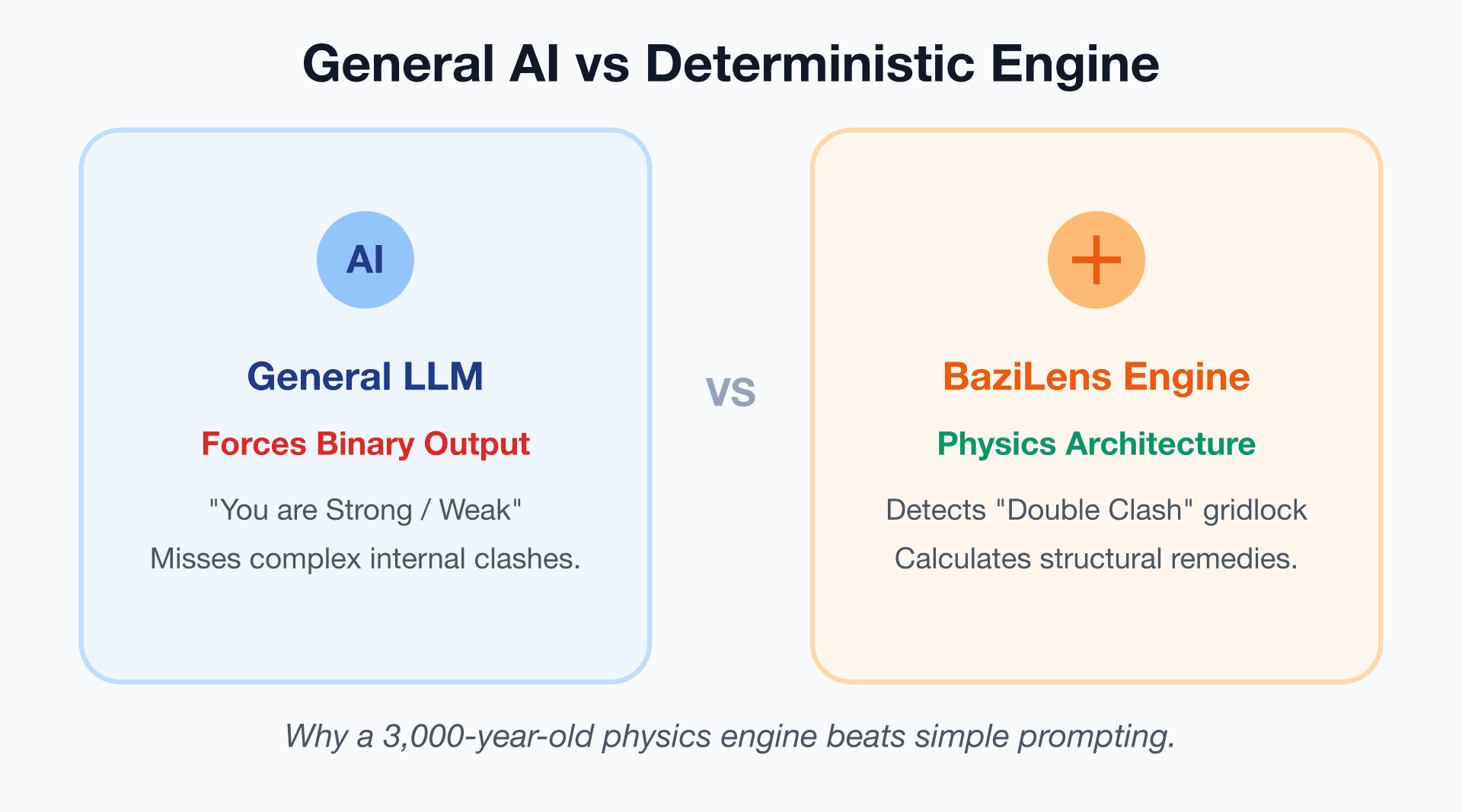
- ●General AI models fail at complex BaZi readings because they force binary "strong vs. weak" labels instead of understanding dynamic structural balance.
- ●A Double Clash (like Water vs. Fire) creates massive internal friction and career gridlock, even if the overall chart is mathematically balanced.
- ●To resolve this friction, you must build a "Dam" (Metal/Routine) before you build a "Turbine" (Wood/Execution) to avoid burning out your core energy.
Core Metaphysics Concepts Explained
- ●Day Master: In BaZi, the Day Master is the core element defining your fundamental nature. Its structural strength dictates which elements benefit or harm you.
- ●Clash: In BaZi, a clash represents a direct elemental conflict (like Water versus Fire), causing internal turbulence, sudden changes, and high friction.
- ●Resource Element (Metal): In BaZi, for a Water Day Master, Metal acts as the Resource star, providing rigid structure, strict logic, boundaries, and discipline.
This user had a Yin Water Day Master. But their chart was a battlefield. They had two heavy Water branches violently clashing with an intense Fire branch. General AI models look at this and panic. They try to force a binary label. But the truth is, this chart was perfectly Balanced—it was just experiencing massive internal turbulence.
The Real-life Case Study
The user came to me feeling like their career was stagnating. They weren't lacking ambition, but they felt gridlocked.
When we broke down the chart without the AI's binary bias, the picture became clear. The Month pillar (Fire) represented their career and external environment, while the Year and Day pillars (Water) represented their internal thoughts. The clash meant their internal operating system was in a constant tug-of-war with their external environment.
Gemini suggested using "Wood" to bridge the gap. Its logic was sound on the surface: Water feeds Wood, and Wood feeds Fire. It argued that Wood acts as a turbine, absorbing the violent water pressure and converting it into electricity (Fire/Wealth).
But here is the fatal flaw the AI missed: The user's chart was balanced, not strong. If you use a turbine to drain a reservoir that isn't overflowing, you just empty your own core foundation. The user was already doing this—burning out by trying to outwork the friction.
Actionable Takeaways & Solutions
Instead of Wood (draining), the user needed Metal (structure).
Metal represents rigid structure, strict logic, boundaries, and discipline. In classical BaZi, it is the Resource Star. By relying on Metal, the user doesn't need to fight the internal clash every single day. They just follow the routine.
The sequence I prescribed was "Dam first, then Turbine." Build the strict financial logic and daily routines first (Metal) to replenish the Water. Once the dam is secure, the act of executing and building systems (Wood) will naturally flow without depleting the core.
When the user fed this counter-argument back to Gemini, the AI actually conceded. It replied: "I have to concede the round... That is an absolute checkmate using classical Ten Gods theory."
The Founder's Perspective
This interaction was the ultimate stress-test for my custom BaZi engine. It proved that while general LLMs are amazing at conversation, they fail at domain-specific deterministic logic. Building BaziLens isn't just about wrapping a prompt around an AI; it's about hardcoding the 3,000-year-old physics engine so the AI has the correct mathematical foundation to interpret.
Frequently Asked Questions
Can AI accurately read a BaZi chart?
General AI models struggle to accurately read complex BaZi charts because they rely on binary pattern matching rather than deterministic elemental physics. They often misdiagnose balanced charts experiencing internal clashes, prescribing the wrong elemental remedies.
A custom-built deterministic BaZi engine is required to calculate the exact structural dynamics before any AI interpretation can be trusted.
How do you resolve a clash in a BaZi chart?
You resolve a clash by introducing a bridging element or a structural anchor that diffuses the tension. For example, in a Water versus Fire clash, you must build strong internal boundaries and routines (Metal element) to stabilize the system.
Fighting the friction directly only depletes your core energy. Building a structural routine allows you to bypass the clash entirely.
Your Next Steps
If you feel like you are working incredibly hard but remain gridlocked by internal friction, you might be dealing with an undetected elemental clash. Stop relying on generic horoscopes or flawed AI prompts. Run your data through BaziLens to calculate your true structural dynamics and get a deterministic diagnostic today.
Related Insights
The Burnout Equation: Why Your BaZi Explains Your Current Exhaustion (And How to Fix It)
Discover why career burnout isn't a flaw in your work ethic, but a structural friction between your Core Engine (Day Master) and your 10-Year Luck Pillar.
Why High-Performers Burn Out: The Career Friction Between Output and Officer Energies
Discover why some high-performers feel hollow in corporate jobs. A deep dive into the BaZi dynamics of 'Output' energy versus strict 'Officer' structures.
The “Tai Sui” Myth: Why Your Zodiac Year Is Not Actually Cursed
Discover why your Chinese Zodiac year (Tai Sui) isn't a curse of bad luck, but rather an extreme amplification of your personal energy ecosystem.
Discussion
0No insights shared yet. Be the first to start the discussion!