The Intimidating Chassis Trap: Overcoming Emotional Bottlenecks
Published on June 29, 2026•5 min read
The Illusion of the "Unshakeable" Foundation
For most of my 20s, I wore my emotional resilience as a badge of honor. People always told me I was "unshakeable." I handled crises without flinching, never asked for help, and built an impenetrable wall around my emotions. From the outside, I looked like a highly optimized, highly functional machine.
But behind closed doors, the reality was entirely different. I was completely suffocated, isolated, and silently burning out. I wasn't actually strong—I was trapped in a systemic bottleneck.
When I started developing the BaziLens framework to map human psychology as a complex operating system, I discovered a very specific bug. It’s a bug that plagues high-performers, eldest siblings, and fiercely independent creators. I call it the "Intimidating Chassis Trap."
Understanding the Psychological Hardware
In my framework, the baseline identity is broken down into five core resources: Wood, Fire, Earth, Metal, and Water.
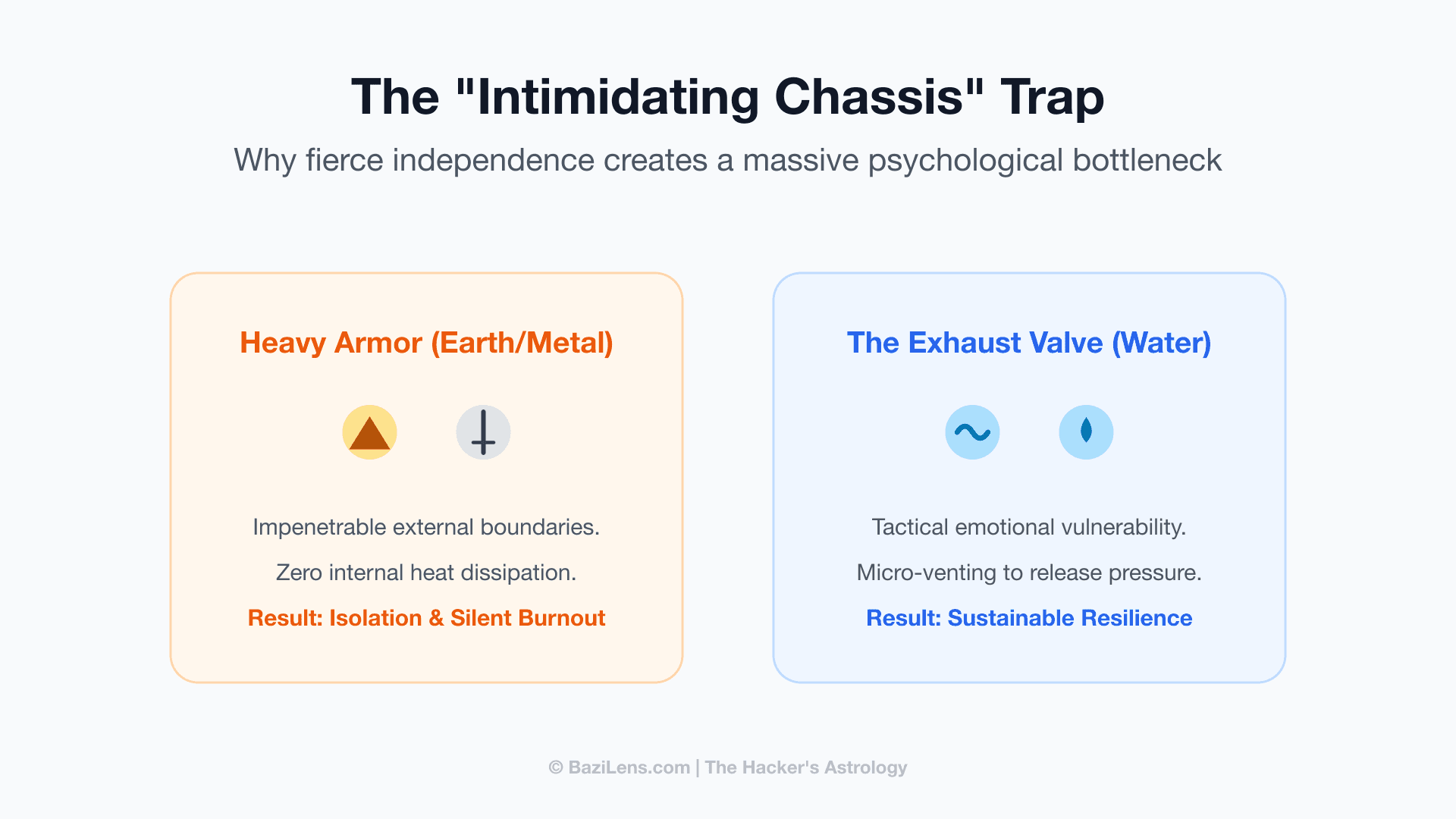
Think of Earth and Metal as your raw hardware. Earth is the foundation, the heavy chassis, the stubborn resilience. Metal is the armor, the precision, the sharp boundaries. Together, they create immense structural integrity.
But a system built entirely of heavy armor with zero exhaust vents is a ticking time bomb.
The Missing Exhaust Valve
If your psychological backend is heavily stacked with Earth and Metal, but completely lacks Water, you create a massive pressure cooker. In this architecture, Water represents fluidity, vulnerability, communication, and emotional cooling.
Without it, you look like an impenetrable fortress on the outside. But inside, your CPU is melting down because there is absolutely no cooling system. You have all the hardware to absorb impact, but zero pathways to release the heat.
Real-World Examples
When talking with users in our community, this pattern shows up repeatedly in high-stakes environments.
Case Study: The Shock Absorber
Alex, a tech lead, possessed a chart heavily dominated by Earth. They built an incredibly rigid external shell to survive a chaotic corporate environment. When conflict happened, they didn't complain; they just absorbed the impact. When they were overwhelmed, they retreated into isolation rather than delegating.
The tragic result? Their managers threw them into the most chaotic, broken projects because they knew Alex would never complain. Alex became the ultimate shock absorber. But while peers were getting promoted for highly visible, fluid output, Alex was stuck doing the invisible, thankless maintenance work of holding the structural integrity of the team together, leading to severe burnout.
Case Study: The Silent Partner
Mei, an entrepreneur with strong Metal elements, struggled with romantic relationships. Because her "armor" was so effective, she radiated absolute self-sufficiency. Partners leaned entirely on her stable foundation. But the moment Mei needed to lean back, her partners panicked—because Mei had accidentally trained them to believe her foundation could never crack. She ended up feeling utterly alone while sleeping right next to someone.
The Vicious Feedback Loop
The Intimidating Chassis Trap creates a brutal, invisible paradox in your social dynamics. Because you look terrifyingly competent to everyone else, people assume you never need help.
Friends stop checking in on you. Partners assume you have everything perfectly under control. This triggers a vicious feedback loop: The more resilient you look, the less support you receive. The less support you receive, the more isolated you feel. And to survive that painful isolation, you build even thicker armor.
It is a catastrophic memory leak. You are burning 90% of your daily energy just holding the heavy armor up, leaving zero bandwidth for actual connection, joy, or creative output. You aren't protecting yourself anymore. You are quarantining yourself.
Practical Adjustments: Installing the Patch
You don't need to undergo years of therapy to learn how to be "softer." You just need to install a simple, tactical exhaust port in your hardware.
To patch this vulnerability, you must artificially inject "Water" into your daily operating system. Water is tactical vulnerability. It is the intentional dismantling of your armor in strictly controlled, safe environments.
The Boundary Hack: Micro-Venting
Stop waiting for a catastrophic meltdown to communicate your bandwidth limits. Start micro-venting. Instead of waiting until you are completely broken to ask for help, share a minor, low-stakes struggle with a trusted friend today.
When someone asks how you are doing, temporarily disable the "I'm fine, just busy" auto-responder. Try saying, "I'm actually pretty overwhelmed with this specific problem, could I just vent for two minutes?"
Force yourself to delegate a task you know you could do perfectly yourself, simply to practice relinquishing control.
Final Reflections
You don't have to dismantle the entire fortress. You don't have to become someone you are not. You just need to open one small window to let the heat out. Allowing yourself to be temporarily fragile is the only way to sustain long-term strength.
Your impenetrable emotional armor isn't a superpower; it's a structural bottleneck that prevents system cooling and isolates you from support. Stop confusing emotional quarantine with resilience.
Let's stop guessing, and start debugging. Map your own psychological operating system at BaziLens.
Related Insights
The Burnout Equation: Why Your BaZi Explains Your Current Exhaustion (And How to Fix It)
Discover why career burnout isn't a flaw in your work ethic, but a structural friction between your Core Engine (Day Master) and your 10-Year Luck Pillar.
Why High-Performers Burn Out: The Career Friction Between Output and Officer Energies
Discover why some high-performers feel hollow in corporate jobs. A deep dive into the BaZi dynamics of 'Output' energy versus strict 'Officer' structures.
The “Tai Sui” Myth: Why Your Zodiac Year Is Not Actually Cursed
Discover why your Chinese Zodiac year (Tai Sui) isn't a curse of bad luck, but rather an extreme amplification of your personal energy ecosystem.
Discussion
0No insights shared yet. Be the first to start the discussion!