The Ultimate Guide to Decoding Your Destiny: Where to Start with Chinese Astrology (BaZi)
Published on July 2, 2026•5 min read
The Zodiac Myth: Why You Are Not Just "A Pig"
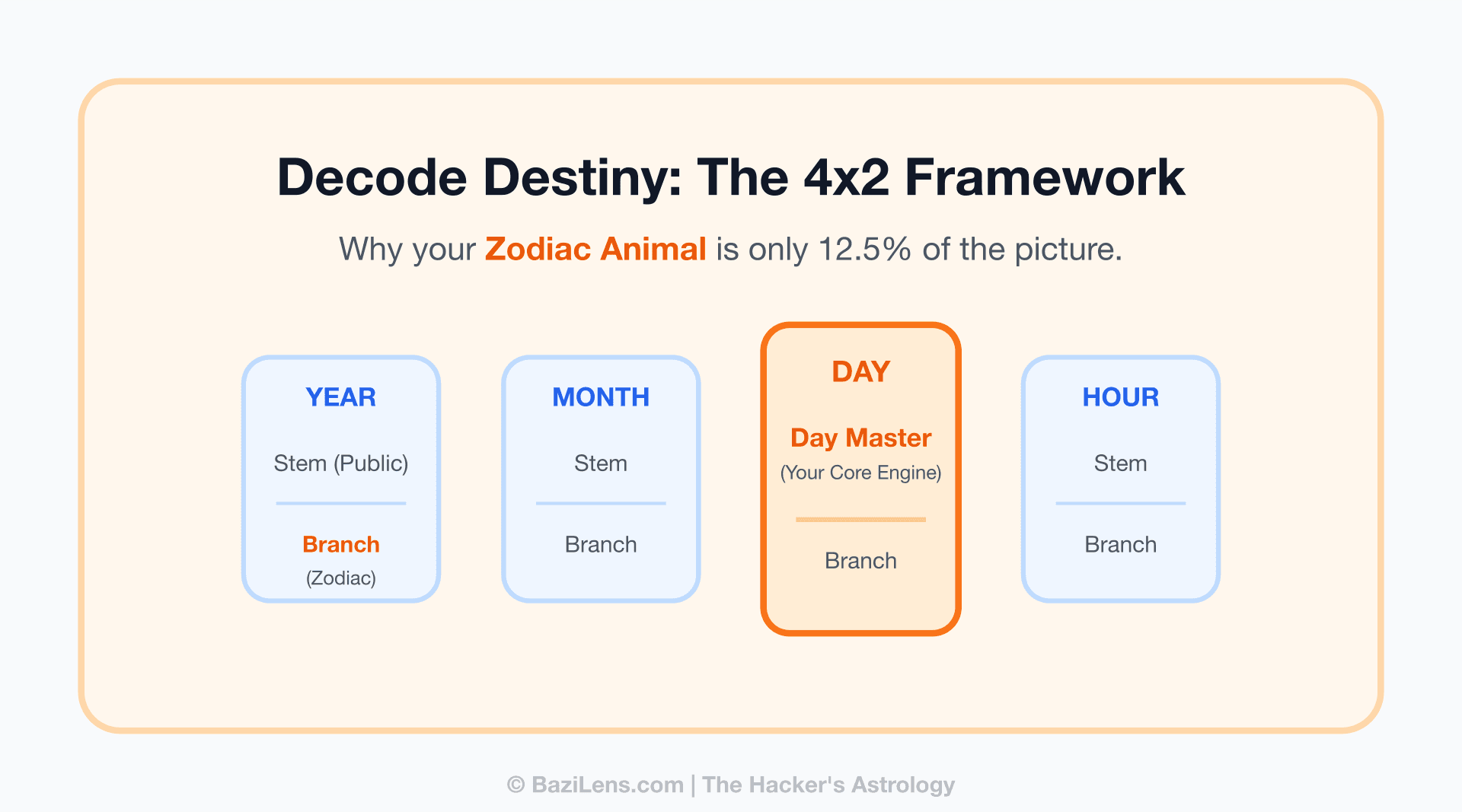
When most people first encounter Chinese astrology, they stop at their birth year. You might hear someone say, "I'm a Fire Pig," or "I'm a Water Dragon." While this is a fun icebreaker, it is fundamentally incomplete. Your birth year—the Zodiac animal everyone talks about—represents only 12.5% of your actual astrological blueprint.
My observational framework, based on the ancient BaZi (Four Pillars of Destiny) system, treats your life as a 4x2 matrix. You have four pillars representing the Year, Month, Day, and Hour of your birth. Each pillar consists of two layers: a Heavenly Stem (surface energy) and an Earthly Branch (deep foundation).
If you are only reading your yearly Zodiac sign, you are reading the title of the book and ignoring the remaining 300 pages of the story. To truly decode your destiny, you must look at the complete architectural structure of your chart.
The Core Engine: Finding Your Day Master
If the Zodiac sign is just the outer shell, what is the core? The answer is the Day Master.
Your Day Master is the Heavenly Stem of your Day Pillar. In my custom system, we treat this as your absolute core operating system. Forget the animal signs for a moment—the Day Master reveals who you actually are beneath societal conditioning and outward appearances.
There are 10 possible Day Masters, representing Yin and Yang variations of the Five Elements (Wood, Fire, Earth, Metal, Water). For instance, a Yang Wood person operates like a towering pine tree—driven by growth, rigid in principles, and always reaching upward. A Yin Fire person operates like a candle flame—flickering, illuminating, intuitive, and capable of sparking immense inspiration but prone to burning out without a steady fuel source.
Understanding your Day Master is step one. It defines your baseline needs, your natural learning style, and your inherent psychological drivers.
The Energy Dynamics: How Your System Runs
A common misconception is that having "too much" of a certain element is a superpower. In reality, this framework isn't about collecting elements like trading cards; it's about how they interact in a living ecosystem.
Your chart is a dynamic engine governed by feedback loops—specifically, the Generating and Controlling cycles of the Five Elements.
- ●The Generating Cycle (Input/Output): Wood fuels Fire, Fire creates Earth (ash), Earth bears Metal (ore), Metal condenses Water, Water nourishes Wood.
- ●The Controlling Cycle (Regulation): Wood parts Earth, Earth absorbs Water, Water extinguishes Fire, Fire melts Metal, Metal chops Wood.
If you have a massive amount of Fire but no Wood to sustain it, your energy output will be explosive but short-lived (classic burnout). If you have too much Metal and no Fire to forge it, you remain raw, untapped potential. Stop trying to memorize abstract terms and start viewing your chart as a living ecosystem that requires constant, deliberate balancing.
The Interface: What People See vs. What Drives You
Have you ever felt like the face you show the world doesn't match your inner drive? There is a structural reason for that in this framework.
Your chart is divided vertically into Heavenly Stems and Earthly Branches. Think of it like a tree:
- ●The Stems (The Leaves): This is the visible interface. It’s what you project to society, how your colleagues see you, and the conscious actions you take.
- ●The Branches (The Roots): This is your private self, your subconscious drives, your hidden potential, and the physical reality of your environment.
Often, a person might project a highly organized, stoic persona (a Metal Stem), but their roots are chaotic, emotionally driven, and fluid (Water Branches). The friction between your Stems and Branches often explains the internal dissonance you feel when navigating career choices or relationships.
Furthermore, your Zodiac animal (the Year Branch) is your most "public" root. How it interacts with your core engine (the Day Master) determines whether your early environment acts as a buff to your growth or a bug you have to constantly debug.
The Application: Career and the 10 Life Roles
How does all this abstract energy translate into actual daily life, career choices, and relationship dynamics? This is where the Ten Gods come in.
In my system, I translate these into the 10 Life Roles. They calculate the relative relationship between every other element in your chart and your Day Master. They represent the roles you naturally fall into: The Rebel, The Strategist, The Competitor, The Nurturer, The Director, etc.
Your Chinese Zodiac sign cannot predict your career. But your Life Roles reveal the exact environment where you will thrive. If your chart is dominated by "The Rebel" (Hurting Officer), you will suffocate in a corporate cubicle but thrive in a highly creative, disruptive startup environment. If you are heavy in "The Director" (Direct Wealth), you are built for resource management, predictable scaling, and structured leadership.
Next Steps
Decoding your destiny is not about predicting a fatalistic future. It is about understanding your baseline code so you can write better software for your life.
Let's stop guessing, and start debugging.
Curious about the exact code driving your life? Visit BaziLens to generate your deep-dive personalized blueprint.
Related Insights
The Burnout Equation: Why Your BaZi Explains Your Current Exhaustion (And How to Fix It)
Discover why career burnout isn't a flaw in your work ethic, but a structural friction between your Core Engine (Day Master) and your 10-Year Luck Pillar.
Why High-Performers Burn Out: The Career Friction Between Output and Officer Energies
Discover why some high-performers feel hollow in corporate jobs. A deep dive into the BaZi dynamics of 'Output' energy versus strict 'Officer' structures.
The “Tai Sui” Myth: Why Your Zodiac Year Is Not Actually Cursed
Discover why your Chinese Zodiac year (Tai Sui) isn't a curse of bad luck, but rather an extreme amplification of your personal energy ecosystem.
Discussion
0No insights shared yet. Be the first to start the discussion!